
If you’re serious about maintaining a healthy, well-manicured lawn, a gas push lawn mower remains one of the most dependable tools you can own. While battery-powered and corded electric mowers have made significant strides in recent years, gas-powered push mowers still hold a commanding lead when it comes to raw cutting power, unlimited runtime, and the ability to tackle challenging grass conditions that would slow or stop other mower types in their tracks.
A gas push lawn mower doesn’t rely on a battery charge or an extension cord. It starts when you need it, runs as long as the job requires, and delivers the kind of consistent torque that makes short work of thick, tall, or damp grass. For homeowners with medium to large yards, properties with variable terrain, or lawns that go longer between cuts than they probably should, a gas push mower isn’t just a good option — it’s often the best one.
This comprehensive guide covers everything you need to know before buying a gas push lawn mower — from how the technology works and which brands lead the market, to what features genuinely matter and how to keep your mower performing at its peak for years to come. Whether you’re buying your first mower or upgrading from an aging machine, you’ll find the clarity and confidence you need right here.

What Makes a Gas Push Lawn Mower the Right Choice for Your Yard
Before diving into specific models and features, it’s worth understanding why a gas push lawn mower continues to be the preferred choice for millions of homeowners despite the growing appeal of battery alternatives.
Unlimited Runtime
This is the defining advantage of any gas-powered machine. When you’re mowing a large yard on a warm afternoon, the last thing you want is for your mower to signal a low battery and force you to stop halfway through. A gas push lawn mower runs as long as there’s fuel in the tank — and refueling takes less than a minute. For yards over half an acre, or for homeowners who prefer to do all their outdoor power tasks in a single session, unlimited runtime is a practical necessity rather than a luxury.
Superior Torque for Tough Conditions
Gas engines produce more torque at low RPM than electric motors of comparable physical size, and that torque advantage becomes apparent the moment you encounter thick grass, wet conditions, or an overgrown section of your yard. A quality gas push lawn mower pushes through these challenges without bogging down, maintaining a consistent blade speed that delivers a clean, even cut across difficult terrain.
Lower Upfront Cost
Premium battery-powered push mowers — particularly those from top-tier brands like EGO — can cost $500 to $800 or more for the mower and a suitable battery. A comparable gas push lawn mower from a reputable brand often comes in at $280 to $450, making it significantly more accessible for budget-conscious homeowners who still want genuine performance.
Widely Available Service and Parts
Gas mowers use engines that have been manufactured in high volumes for decades. Every small engine shop, hardware store, and farm supply retailer carries compatible parts — air filters, spark plugs, oil, belts, and blades — making maintenance simple and inexpensive. In contrast, proprietary battery systems and electric motors can be harder and more expensive to service as mowers age.
Proven Long-Term Durability
A well-maintained gas push lawn mower from a quality brand will routinely deliver 10 to 15 years of reliable service. Some Honda and Husqvarna models remain in active use for 20 years or more with proper care. That kind of longevity represents genuine long-term value that even the best battery mowers have yet to fully demonstrate at scale.
How a Gas Push Lawn Mower Engine Works
Understanding the basics of your gas mower’s engine helps you make better buying decisions, perform basic maintenance with confidence, and troubleshoot minor issues before they become expensive repairs.
Two-Stroke vs. Four-Stroke Engines
Nearly all modern residential gas push lawn mowers use four-stroke (four-cycle) engines. Unlike two-stroke engines — which mix oil and fuel together — four-stroke engines use separate oil and fuel systems, operate more efficiently, produce fewer emissions, and require less frequent maintenance. Four-stroke mowers are the industry standard for good reason.
Two-stroke engines are still found on some handheld tools like trimmers and chainsaws, but they’re essentially obsolete in the push mower segment. If you encounter a gas mower that requires mixing oil into the fuel, approach with caution — it’s almost certainly an older or lower-quality machine.
Engine Displacement and Power Output
Engine displacement — measured in cubic centimeters (cc) — is the most commonly cited power indicator for small engines. For residential gas push lawn mowers, you’ll typically encounter engines ranging from 140cc to 190cc, with most quality self-propelled models falling in the 160cc to 190cc range.
Higher displacement generally means more torque and the ability to handle tougher cutting conditions. For light-duty mowing of maintained, relatively flat lawns, a 140cc to 150cc engine is perfectly adequate. For demanding conditions — tall grass, slopes, thick turf varieties — a 160cc engine or above is the wiser investment.
Key Engine Brands to Know
Briggs & Stratton is the most widely used small engine manufacturer in North America, powering mowers from dozens of different brands. Their engines are reliable, widely serviced, and available in configurations from basic to premium. The EXi and Series 850 engines represent solid mid-range choices, while the Series 1150 and Series 1450 power the more demanding applications.
Honda GCV engines are widely regarded as the gold standard in residential small engine performance. Honda’s overhead cam (OHC) design runs smoother, more efficiently, and more quietly than comparable pushrod engines, and their reputation for longevity is unmatched in the industry. Honda-powered gas push lawn mowers cost more upfront but consistently justify that premium over time.
Kawasaki and Kohler engines appear less frequently in residential push mowers but are highly regarded for their performance and durability when they do. These brands are more commonly found in commercial walk-behind mowers.
Types of Gas Push Lawn Mowers: Finding Your Best Match
Not all gas push lawn mowers are configured the same way. Understanding the key variations helps you narrow down your options quickly.
Standard Push Gas Mowers
A standard push gas mower has no drive system — you provide all the forward motion yourself. The engine’s only job is spinning the cutting blade. These mowers are lighter, simpler, less expensive, and easier to maintain than self-propelled models, and they’re perfectly suited for flat yards where pushing isn’t physically demanding.
Standard push models are the right choice for:
- Flat lawns under 1/3 acre
- Homeowners who prefer a lighter machine that’s easy to lift and maneuver
- Budget-conscious buyers who don’t need drive system features
- Anyone who wants the simplest possible maintenance routine
Self-Propelled Gas Push Mowers
Self-propelled gas mowers add a drive system that moves the mower forward at a controlled pace, requiring you only to guide and steer rather than push. This makes a meaningful difference over extended mowing sessions, particularly on larger yards or properties with slopes.
Front-wheel drive (FWD) self-propelled models engage the front wheels and are best suited for flat terrain with lots of turns and direction changes. When you lift the front wheels to pivot the mower, the drive disengages, making turns smooth and natural.
Rear-wheel drive (RWD) self-propelled models drive the rear wheels and provide significantly better traction on hills and uneven terrain. Rear-wheel drive is the preferred configuration for yards with any meaningful slope, as it pushes from behind rather than pulling from the front — which provides more stable, controlled forward motion on grades.
All-wheel drive (AWD) models engage all four wheels for maximum traction in all conditions. AWD gas push lawn mowers are the most capable and the most expensive in the self-propelled category, genuinely worth the premium for yards with significant slopes, soft soil, or frequently wet grass conditions.
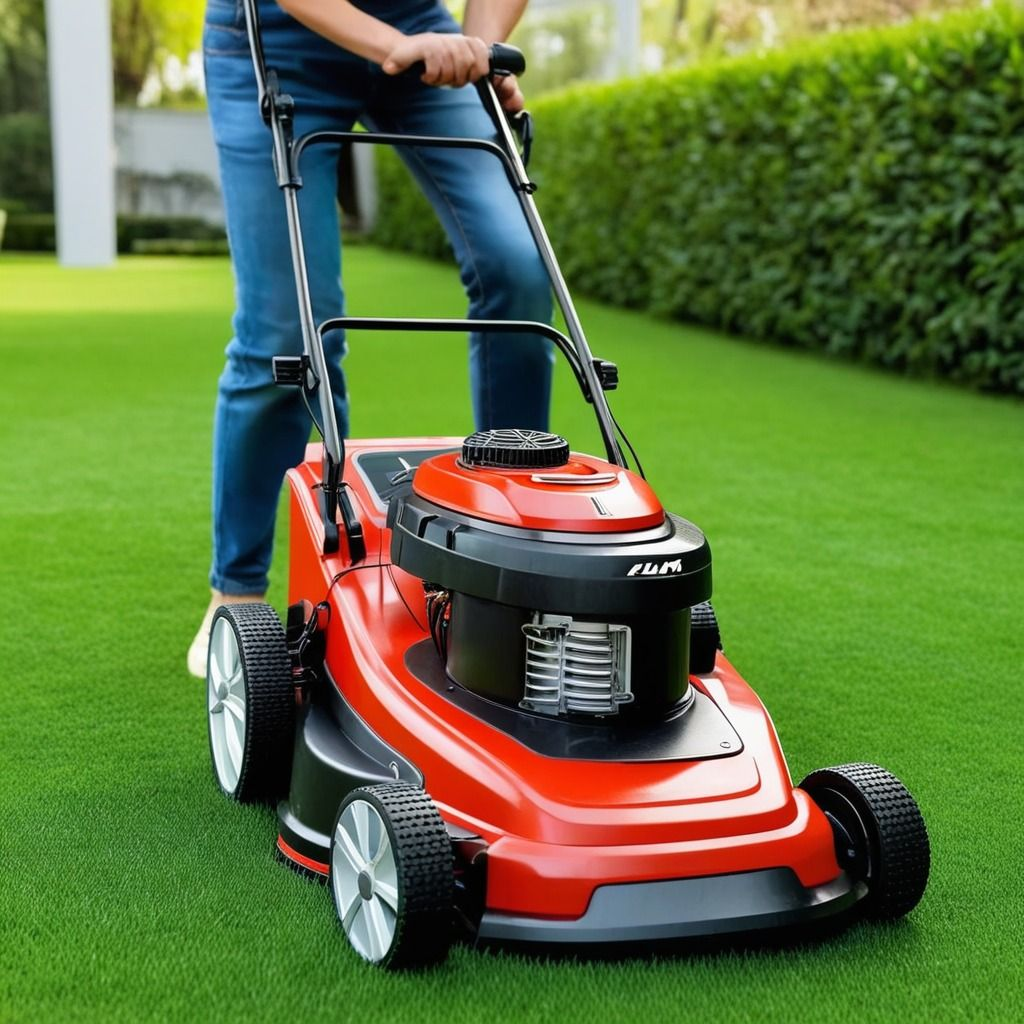
One of the standout options in the self-propelled RWD segment is the Yard Force 21″ Self-Propelled RWD Walk Behind Mower with Vertical Storage Technology, available at Sam’s Club. This mower combines the traction advantages of rear-wheel drive with innovative vertical storage capability — allowing the mower to stand upright when not in use, saving significant garage or shed floor space. For homeowners who struggle with limited storage, this feature alone makes it a compelling option worth serious consideration.
Wide-Area Gas Push Mowers
Wide-area gas push mowers feature cutting decks of 26 inches or wider — significantly larger than the standard 21-inch residential push mower. They’re designed for homeowners with large, relatively open lawns who want to reduce mowing time without committing to a riding tractor.
The tradeoff is weight and maneuverability — wide-area mowers are heavier and harder to turn around obstacles. But for open lawns of half an acre or more, the time savings they provide are genuinely substantial.
Top Features to Prioritize in a Gas Push Lawn Mower
With dozens of models on the market, knowing which features genuinely impact your mowing experience — versus which are marketing fluff — helps you make a smarter purchase.
Cutting Deck Material and Width
The cutting deck is the foundation of any gas push lawn mower, and its material affects both durability and weight.
Steel decks are the most common in the residential segment. Heavy-gauge steel decks are highly durable but add weight. Look for decks with a rust-resistant coating or treatment — particularly important if you live in a humid climate.
Aluminum decks are lighter than steel and naturally rust-resistant, but they can dent more easily on impact with rocks or debris. Some premium Honda models use their proprietary NeXite polymer deck — exceptionally durable, completely rust-proof, and lighter than steel.
For deck width, the 21 to 22-inch range remains the sweet spot for most residential gas push lawn mowers. It strikes the ideal balance between coverage per pass and maneuverability around landscaping features.
Single-Lever Height Adjustment
Cutting height adjustment is a feature that sounds minor but becomes genuinely important in day-to-day use. Lower-end gas push mowers require you to adjust each wheel individually — a tedious process that most homeowners simply avoid, leading to suboptimal cutting heights year-round.
Single-lever height adjustment changes all four wheels simultaneously with one motion. It makes adapting to seasonal cutting height changes — cutting higher in summer heat, lower in spring and fall — fast and effortless. This is a feature worth paying a modest premium for.
3-in-1 Discharge Capability
The best gas push lawn mower options offer bagging, mulching, and side discharge in a single machine, configurable with a simple plug change or lever.
Mulching is ideal for regular maintenance mowing — finely chopped clippings are returned to the lawn as natural fertilizer, feeding the soil and reducing your need for supplemental nutrients. Bagging is necessary when grass has grown too long or too thick for effective mulching. Side discharge is useful for very tall grass that would overwhelm a mulching system.
A 3-in-1 mower gives you the flexibility to use the right discharge method for the conditions you actually encounter rather than being locked into one approach.
Blade Brake Clutch (BBC) System
A blade brake clutch system allows you to stop the cutting blade without killing the engine. This is both a safety feature and a significant convenience — you can stop the blade to move an obstacle, cross a non-grass surface, or take a break, then re-engage the blade without going through the starting sequence again.
On longer mowing sessions with frequent interruptions, a BBC system saves considerable time and starting-cord wear.
Washout Port
A deck washout port is a simple but highly practical feature — a threaded fitting on top of the cutting deck where you can connect a garden hose to flush grass buildup from inside the deck while the blade is spinning. It’s far more effective than scraping with a brush, and it dramatically reduces the buildup of compacted grass that can eventually cause deck corrosion.
If you mulch regularly — which means clippings accumulate inside the deck rather than being discharged — a washout port is a feature worth specifically seeking out.
Handle Comfort and Foldability
Handle ergonomics matter more than most pre-purchase product reviews acknowledge. Padded, cushioned handles reduce vibration fatigue on long mowing sessions. Adjustable handle height ensures the mower is comfortable for users of different heights — particularly important if multiple family members share the mower.
Foldable handles allow the mower to be stored compactly in tight garage spaces. Some models, like the Yard Force mower mentioned earlier, take this further with vertical storage technology that allows the entire mower to stand upright — dramatically reducing its floor footprint in crowded storage spaces.
Best Gas Push Lawn Mower Picks for Different Needs
Here’s a breakdown of the standout gas push mower choices across key categories to help you identify the best fit for your specific situation.
Best Overall Gas Push Lawn Mower: Honda HRX217VKA
Honda’s HRX series is widely regarded as the pinnacle of residential gas push lawn mower engineering. The HRX217VKA features Honda’s proprietary MicroCut twin-blade system — two blades working in opposing directions to produce a finer mulch and cleaner cut than any single-blade design can achieve. The NeXite deck is rust-proof and near-indestructible. The GCV200 engine starts reliably, runs smoothly, and will outlast several competitor mowers with proper care.
It’s not the cheapest gas push mower on the market, but for homeowners who want the absolute best performance and the longest possible service life, the Honda HRX217VKA earns its price premium.
Best Budget Gas Push Lawn Mower: CRAFTSMAN M215
The CRAFTSMAN M215 delivers dependable gas push mower performance at a price point that competes directly with entry-level battery mowers. It features a 163cc Briggs & Stratton engine, 21-inch 3-in-1 deck, and 6-position height adjustment — all the core features you need without the premium pricing.
For homeowners who want a reliable, no-frills gas push mower for straightforward residential mowing, the CRAFTSMAN M215 is one of the best values currently available.
Best Self-Propelled Gas Push Mower for Hills: Yard Force 21″ RWD Self-Propelled Mower
For homeowners who need reliable rear-wheel drive traction on sloped terrain combined with practical storage innovation, the Yard Force 21″ Self-Propelled RWD Walk Behind Mower at Sam’s Club is a standout pick. The rear-wheel drive system provides confident traction going uphill, while the vertical storage technology solves one of the most common frustrations of gas mower ownership — the amount of floor space these machines consume in a garage or shed.
This is a genuinely practical machine for the homeowner who needs hill-capable self-propulsion and has limited storage space — a combination that’s harder to find than it should be in the residential mower market.
Best Gas Push Mower for Large Lawns: Toro TimeMaster 30-Inch
Toro’s TimeMaster brings a 30-inch cutting deck to the push mower format, reducing mowing time by roughly 33% compared to a standard 21-inch machine. It’s self-propelled with Toro’s personal pace drive system, which automatically matches forward speed to your natural walking pace — a feature that feels intuitive from the very first use.
For homeowners with open lawns approaching or exceeding one acre who prefer walking over riding, the TimeMaster is a genuinely compelling alternative to a riding tractor.
Best Gas Push Mower for Reliability: Husqvarna HU800AWDH
Husqvarna’s HU800AWDH brings all-wheel drive capability, a high-output Briggs & Stratton engine, and heavy-gauge steel deck construction to a self-propelled push mower platform that handles the most demanding residential conditions with ease. Husqvarna builds this mower to a standard that approaches commercial quality, making it an excellent choice for homeowners who want a machine that will genuinely last.
Gas Push Lawn Mower Maintenance: Keeping Your Mower at Peak Performance
A gas push lawn mower rewards consistent maintenance with years of reliable service. Neglect it, and you’ll face frustrating starting problems, reduced cutting performance, and eventual expensive repairs. Here’s the maintenance schedule every gas mower owner should follow.
Pre-Season Startup Checklist
Before your first mow of the season, work through this checklist to ensure your mower is ready to perform:
Engine oil: Check the oil level before every use during the season, but change the oil at the start of each season with the manufacturer’s recommended grade. Most residential gas push lawn mowers use SAE 30 oil in warm weather conditions or 10W-30 for variable temperature climates.
Spark plug: Replace the spark plug annually. A fresh spark plug ensures reliable starting and complete combustion. Spark plugs are inexpensive — typically $3 to $6 — and take less than ten minutes to change. Don’t skip this step.
Air filter: A clogged air filter starves the engine of clean air, reducing power and increasing fuel consumption. Clean foam air filters with mild soap and water, and replace paper cartridge filters annually or when visibly dirty.
Cutting blade: Inspect the blade for damage and test sharpness. A blade that’s been in service all season almost certainly needs sharpening before the new season begins. More on blade maintenance below.
Fuel system: If you stored the mower with a fuel stabilizer, it should start readily. If you stored it with untreated fuel, drain any remaining gas and start the season with a fresh fill. Stale gasoline is the single most common cause of hard-starting gas push lawn mower issues.
Mid-Season Maintenance
During the mowing season, stay on top of these key maintenance items:
- Check oil level before every third or fourth mowing session — gas engines can consume small amounts of oil over time, and running low can cause serious engine damage
- Clean the underside of the deck every 3–5 uses to prevent grass buildup from impeding airflow and causing premature deck corrosion
- Inspect the blade for damage after any encounter with rocks, roots, or hard debris — a bent or chipped blade causes vibration that stresses the engine and crankshaft
- Check air filter monthly during heavy use periods and clean as needed
End-of-Season Winterization
Proper winterization is the single most impactful step you can take for long-term gas push lawn mower reliability. Many mowers that “won’t start” in spring are simply suffering from the effects of improper storage the previous fall.
Fuel management is the most critical step. Either run the mower until the fuel tank and carburetor are completely empty, or add a quality fuel stabilizer to a full tank, run the engine for several minutes to circulate the treated fuel through the carburetor, then store. Untreated ethanol-blend gasoline begins to degrade in as little as 30 days, leaving behind varnish deposits that clog carburetor jets and fuel passages.
Final oil change: Changing the oil before winter storage removes combustion acids and metal particles that accumulate in used oil and can corrode engine internals during months of storage.
Blade removal and sharpening: Remove the blade, sharpen or replace it, and reinstall before storage — that way your mower is ready to go at the start of spring without any delay.
Storage environment: Store your gas push lawn mower in a dry location away from temperature extremes. Moisture promotes rust on metal components, and extreme cold can cause fuel system components to contract and crack over time.
Blade Sharpening: The Most Impactful Maintenance Step
No maintenance action has a more immediate or visible impact on cut quality than keeping your blade sharp. A sharp blade cuts grass cleanly with a single pass, leaving a smooth edge that heals quickly and maintains its green color. A dull blade tears and shreds grass, leaving ragged brown tips that make even a freshly mowed lawn look unhealthy.
Sharpen your gas push lawn mower blade at least once per season — more frequently if you mow regularly, have a large yard, or frequently encounter sand, dirt, or debris. The most accessible option is to take the blade to a local hardware store or small engine shop for sharpening — typically $10 to $15 and completed while you wait.
If you prefer to sharpen your own blades, a handheld metal file or angle grinder with a sharpening disc both work well. The key is maintaining the original bevel angle of the blade edge — typically 30 to 35 degrees — and ensuring the blade remains balanced after sharpening. An unbalanced blade causes vibration that stresses the crankshaft bearing over time.
Gas Push Lawn Mower Safety: Protecting Yourself and Others
Gas push lawn mowers are powerful machines that deserve genuine respect. Following established safety practices protects you, your family, and your property from the serious injuries that result from careless mower operation.
Before mowing:
- Walk the entire mowing area and remove rocks, sticks, toys, hoses, and any other debris that could become a dangerous projectile if struck by the blade
- Ensure all bystanders — especially children and pets — are well clear of the mowing area
- Check that all guards and safety shields are in place and undamaged
- Never remove or bypass the blade control bail — it’s a critical safety feature, not an inconvenience
While mowing:
- Wear sturdy closed-toe footwear — never mow in sandals, flip-flops, or bare feet
- Use hearing protection during extended mowing sessions — gas mowers produce sound levels that can cause cumulative hearing damage over time
- Eye protection is highly recommended — even small stones ejected from the deck at blade speed can cause serious eye injury
- Never reach under the deck while the engine is running — always disconnect the spark plug before any blade contact
- On slopes, mow across the slope (horizontally) rather than up and down to prevent loss of control
- Never leave a running mower unattended
Fuel handling:
- Always fill the fuel tank outdoors, away from open flames or ignition sources
- Let the engine cool for several minutes before refueling — never add fuel to a hot engine
- Store gasoline in approved containers away from living areas and heat sources
- Wipe up any fuel spills immediately before starting the engine
Frequently Asked Questions About Gas Push Lawn Mowers
How long does a gas push lawn mower last? A well-maintained gas push lawn mower from a quality brand should provide 10 to 15 years of reliable service under normal residential use. Honda and Husqvarna models are particularly known for longevity, with many owners reporting 15 to 20 years of active service life. Consistent maintenance — particularly annual oil changes, spark plug replacement, and proper fuel management — is the primary determinant of long-term engine health.
What type of gas should I use in my gas push lawn mower? Most residential gas push lawn mowers are designed to run on regular unleaded gasoline with a minimum octane rating of 87. Critically, use fuel with no more than 10% ethanol content (E10). Higher ethanol blends — particularly E15 and E85 — can damage carburetor components, fuel lines, and seals in small engines not designed for high-ethanol fuels. Look for ethanol-free fuel if available in your area for the best long-term carburetor health.
Is a self-propelled gas mower worth the extra cost? For yards over 1/3 acre or any yard with meaningful slopes, a self-propelled gas push lawn mower is worth the premium without question. The reduction in physical fatigue over a long mowing session is significant, and rear-wheel drive models provide traction on hills that simply isn’t possible with a standard push mower. For small, flat yards, a standard push model is adequate and the savings are real.
Why won’t my gas push lawn mower start? The most common causes of a no-start gas mower are stale or contaminated fuel, a clogged carburetor (often from old fuel), a fouled spark plug, or a dirty air filter. Start with fresh fuel and a new spark plug — these two steps resolve the majority of no-start issues. If the problem persists, carburetor cleaning or replacement is the likely next step.
How do I know when to replace vs. repair my gas push lawn mower? A useful rule of thumb: if a single repair costs more than 50% of the replacement cost of the mower, replacement is usually the smarter financial decision — particularly for older mowers where additional problems are likely to follow. For younger mowers in otherwise good condition, repair is almost always worth it.
Final Thoughts: Why a Gas Push Lawn Mower Remains the Gold Standard
Electric and battery mowers continue to improve, and for many homeowners — particularly those with smaller yards and a preference for quieter, lower-maintenance operation — they’re an excellent choice. But the gas push lawn mower remains the benchmark against which all other push mowers are measured, and for good reason.
Unlimited runtime, superior torque under demanding conditions, lower upfront cost, widely available service support, and a proven track record of long-term durability combine to make gas-powered push mowing the right choice for a wide range of homeowners — particularly those with medium to large yards, challenging terrain, or demanding grass conditions.
Whether you choose a premium Honda for ultimate performance and longevity, a value-priced CRAFTSMAN for dependable everyday use, or a feature-rich self-propelled model like the Yard Force 21″ RWD Walk Behind Mower with Vertical Storage Technology from Sam’s Club for practical hill-capability and smart storage design, the right gas push lawn mower is out there — and it will reward you with a beautifully maintained lawn season after season.
Ready to find the perfect model for your yard? Visit our lawn mower shop for expert comparisons, curated recommendations, and the guidance you need to invest confidently in a gas push lawn mower that fits your lawn, your budget, and your expectations for years of reliable service.