
Uncategorized
Electric Brush Cutter: The Best Powerful Options That Deliver Amazing Results 100%

Mar
If overgrown weeds, thick brush, and stubborn vegetation have taken over sections of your yard, garden, or property, an electric brush cutter might be the single most effective tool you can add to your outdoor equipment lineup. Unlike standard string trimmers that struggle against anything thicker than light grass, a brush cutter is purpose-built to slice through dense vegetation — woody stems, brambles, saplings, thick weed clusters, and overgrown field grass — with speed and precision that nothing else in the handheld power tool category can match.
The shift toward electric power in the outdoor equipment world has been nothing short of transformative, and brush cutters are no exception. Today’s best electric brush cutter models deliver cutting performance that was once exclusive to gas-powered tools, wrapped in a package that starts instantly, runs quietly, produces zero direct emissions, and requires dramatically less maintenance than any combustion-powered alternative.
Whether you’re a homeowner reclaiming a neglected corner of your yard, a hobby farmer managing fence lines and pasture edges, or a landscaping professional looking to expand your battery-powered toolkit, this guide covers everything you need to make a smart, well-informed electric brush cutter purchase. We’ve broken down the major types, leading brands, essential features, and top picks across every budget — so you can stop guessing and start cutting.
Why an Electric Brush Cutter Is the Smart Choice Right Now
The outdoor power equipment industry has been undergoing a quiet revolution over the past decade, driven by rapid advances in lithium-ion battery technology, brushless motor engineering, and lightweight composite materials. The result is a new generation of electric tools that don’t just match their gas counterparts — in many real-world applications, they outperform them.
Here’s why choosing an electric brush cutter over a gas model makes compelling sense for most users in 2024.
Zero Warm-Up, Instant Performance
Gas brush cutters require priming, choking, and repeated pull-starting — a process that can be genuinely frustrating, especially with a cold engine at the start of the season or after extended storage. An electric brush cutter starts with a single button press, every single time, with zero warm-up required. Full cutting power is available the instant you pull the trigger.
Dramatically Reduced Maintenance
Gas brush cutters demand regular attention: fuel mixing (for two-stroke models), carburetor cleaning, spark plug replacement, air filter changes, and the constant headache of managing fuel that can go stale and gum up internal components during storage. An electric brush cutter eliminates virtually all of this. The maintenance checklist shrinks to blade inspection, occasional cleaning, and battery care — tasks that take minutes rather than hours.
Quieter Operation That Respects Your Neighbors
Gas brush cutters are notoriously loud — many produce noise levels above 95 decibels, which is well into the range where hearing protection becomes mandatory. Electric models typically operate at 75–85 decibels, a meaningful reduction that allows for comfortable operation without ear protection in many cases and makes early morning or evening use in residential areas far more socially acceptable.
Cleaner, Healthier Operation
Two-stroke gas brush cutters mix oil directly into their fuel, producing exhaust that contains significantly higher concentrations of hydrocarbons and particulate matter than four-stroke engines. Cordless electric brush cutters produce zero direct exhaust emissions — better for air quality, better for the environment, and better for your own respiratory health during extended use sessions.
The Battery Ecosystem Advantage
If you already own battery-powered outdoor tools from a major platform — EGO, Greenworks, DEWALT, Milwaukee, or STIHL — there’s a strong chance that a compatible electric brush cutter exists within that same ecosystem. Using a shared battery platform across your trimmer, mower, blower, and brush cutter dramatically reduces the cost of ownership and eliminates the need to manage multiple charging systems.
Types of Electric Brush Cutters: Finding Your Best Match
Not every electric brush cutter is built for the same job, and understanding the distinctions between types will help you choose a tool that’s genuinely suited to your cutting tasks.
Cordless Battery-Powered Brush Cutters
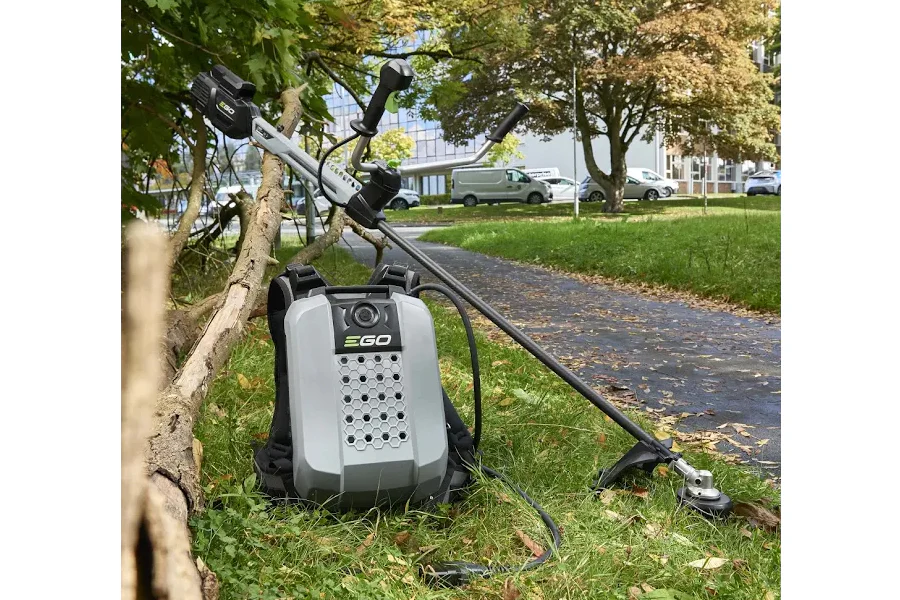
Battery-powered brush cutters represent the fastest-growing segment of the market, and for good reason. They combine the freedom of movement you get with a gas tool with the convenience and cleanliness of electric power. Modern 40V, 56V, and 80V lithium-ion platforms deliver more than enough power for the vast majority of brush-cutting tasks that residential and light commercial users encounter.
Best for: Homeowners and hobby farmers managing fence lines, overgrown yards, pasture edges, and general brush clearing on properties up to a few acres. Also excellent for landscaping professionals building battery-powered tool fleets.
Key advantages: Complete freedom of movement, no cord management, shared battery compatibility with other tools, minimal maintenance, and instant starting.
Key limitations: Battery run time (typically 30–60 minutes per charge under load) requires planning for larger clearing jobs. High-capacity batteries add weight to an already substantial tool.
Corded Electric Brush Cutters
Corded models connect directly to a standard electrical outlet via an extension cord, offering unlimited run time at a lower purchase price than battery-powered alternatives. They’re lighter than battery models (no heavy battery pack) and deliver consistent power without any concerns about charge depletion.
Best for: Users with small to medium properties who have easy access to outdoor power outlets and don’t mind managing an extension cord during operation.
Key advantages: No battery cost, unlimited run time, lighter weight, lower purchase price, and consistent power delivery throughout use.
Key limitations: Extension cord creates a genuine tripping hazard and limits range from the outlet. Cord management during brush cutting — particularly in heavy vegetation — requires constant attention and can significantly slow your work pace.
Multi-Tool System Brush Cutters
Several major manufacturers offer modular multi-tool systems where a single powerhead drives interchangeable attachments — including brush cutter heads, string trimmer heads, hedge trimmer blades, pole saw attachments, and more. These systems represent excellent value for users who need multiple tools but want to minimize the number of motors and batteries they own and maintain.
Best for: Homeowners and professionals who need the versatility of multiple tools but want to manage a single power source and battery platform.
Key advantages: Exceptional versatility per dollar spent, single battery charges all attachments, reduced storage space compared to owning multiple standalone tools.
Key limitations: Powerhead and multiple attachments represent a higher initial investment than a single standalone brush cutter. Switching between attachments adds time during mixed-task work sessions.
Key Features to Evaluate in Any Electric Brush Cutter
When comparing electric brush cutter models, it’s easy to get lost in specification sheets and marketing claims. These are the features that genuinely determine whether a brush cutter will perform well in real-world conditions.
Motor Type: Brushed vs. Brushless
This is arguably the single most important technical specification in any electric brush cutter. Brushless motors are significantly more efficient than brushed motors — they convert a higher percentage of battery energy into cutting power, generate less heat, and experience dramatically less mechanical wear because they eliminate the physical carbon brushes that erode over time in conventional motors.
In practical terms, a brushless electric brush cutter will run longer per charge, deliver more consistent torque under load, and last significantly longer before requiring motor service. For a tool you’re going to use hard in demanding vegetation, a brushless motor is worth every additional dollar.
Voltage and Battery Capacity
Voltage (V) determines the power ceiling of the tool, while amp-hours (Ah) determine how long it can sustain that power output. Higher voltage platforms — 56V, 60V, 80V — provide more torque for cutting through thick woody stems and dense brush. Higher Ah ratings extend run time before recharging is needed.
For light to moderate brush cutting (weeds, tall grass, light woody growth), a 40V platform with a 4.0 Ah battery is generally sufficient. For heavier work involving thick brambles, woody saplings, and dense field vegetation, a 56V or 80V platform with a 5.0 Ah or larger battery will deliver a more satisfying experience and handle demanding conditions without bogging down.
Cutting Blade Compatibility
A brush cutter’s capability is determined not just by its motor but by the cutting attachments it supports. The best electric brush cutter models accept a range of interchangeable blades for different vegetation types:
- 3-tooth grass blades: Ideal for thick grass and light weeds
- 8-tooth or 10-tooth brush blades: Handle heavier brush, brambles, and light woody growth
- 80-tooth circular saw blades: For small saplings and genuinely woody vegetation
- Nylon string head: For transitioning between brush cutting and standard trimming in a single session
The more blade options a model supports, the more versatile it becomes across different clearing tasks. Always confirm what blade types are compatible before purchasing.
Shaft Style: Straight vs. Curved
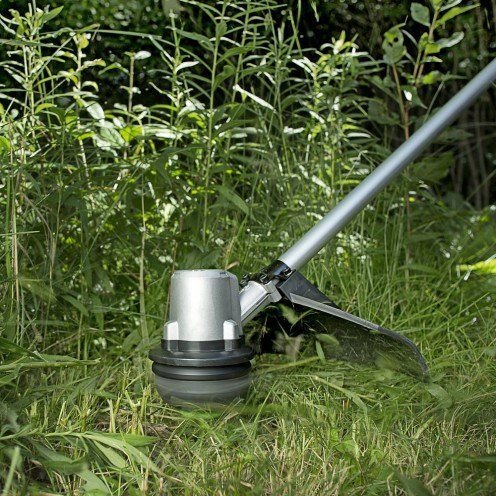
Brush cutters are predominantly built with straight shafts, and for good reason. A straight shaft provides better reach under fences, into corners, and along sloped terrain. It also supports heavier blade configurations more effectively than a curved shaft, which can flex under the torque loads generated by thick cutting blades.
Curved shaft models are lighter and better balanced for standard string trimming but are generally not recommended as serious brush cutting tools. When shopping for an electric brush cutter, stick to straight-shaft designs for genuine brush cutting capability.
Harness and Balance
Full-size brush cutters are substantially heavier than standard string trimmers — often 12 to 20 pounds with battery — and are designed to be worn via a shoulder harness rather than held entirely in the hands. A quality harness system distributes the tool’s weight across your shoulders and hips, dramatically reducing operator fatigue during extended clearing sessions.
Look for models that include a padded, adjustable harness with a swivel attachment point at the tool’s balance point. Anti-vibration handle systems are an additional comfort feature worth seeking — they isolate engine vibration from the handle grips, reducing hand and arm fatigue during long use sessions.
Guard and Safety Features
Brush cutters throw debris with significant force, making proper guarding essential. A full-width blade guard should be standard on any model you consider. Look for guards that are adjustable in position — allowing you to optimize protection based on your cutting angle — without being so restrictive that they interfere with maneuverability in dense vegetation.
Electronic blade brake systems — which stop the blade within seconds of releasing the trigger — are an important safety feature that the best electric brush cutter models include as standard. Never operate a brush cutter without the guard in place, and always wear appropriate personal protective equipment including safety glasses, hearing protection, long pants, and sturdy footwear.
Top Electric Brush Cutter Brands Leading the Market
EGO Power+ — Best Electric Brush Cutter Platform Overall
EGO’s 56V Arc Lithium platform has become the benchmark against which other battery-powered outdoor equipment brands are measured, and their brush cutter offerings — particularly the BCX3800 — live up to that standard. The BCX3800 features a commercial-grade brushless motor, accepts multiple blade types, and delivers run times sufficient for serious clearing jobs on a single charge.
What elevates EGO above competitors is the depth and maturity of their battery ecosystem. The 56V batteries that power their brush cutter are identical to those used in their mowers, trimmers, blowers, and other tools — making EGO an outstanding platform investment for homeowners who want to build a comprehensive, unified outdoor power toolkit.
DEWALT — Best Electric Brush Cutter for Professionals
DEWALT’s FLEXVOLT 60V platform represents one of the most capable cordless systems available to professional landscapers and serious enthusiasts. Their DCBL772 brushless attachment-capable powerhead supports a brush cutter attachment that delivers genuinely impressive cutting performance on tough vegetation.
The FLEXVOLT advantage is unique: their 60V batteries also operate in 20V mode, making them compatible with the enormous range of DEWALT 20V MAX tools already in millions of professionals’ hands. If you’re invested in the DEWALT ecosystem, their brush cutter attachment is a logical, high-value addition.
STIHL — Best Electric Brush Cutter for Serious Operators
STIHL has built a legendary reputation in professional outdoor power equipment over decades, and their battery-powered brush cutter lineup — particularly the FSA 130 R and FSA 90 R — brings that professional standard to cordless operation. STIHL’s AK and AP battery systems power their brush cutters with the kind of smooth, controlled torque that professionals expect from a STIHL product.
STIHL’s brushless motor technology and heavy-duty blade compatibility make their electric brush cutters among the most capable on the market for truly demanding clearing work. Their tools are available exclusively through authorized STIHL dealers — a buying experience that includes expert setup guidance and access to genuine parts and service.
Greenworks — Best Electric Brush Cutter for Budget Buyers
Greenworks offers one of the most accessible entry points into battery-powered brush cutting with their 40V and 80V platform tools. Their 80V Brushless Brush Cutter in particular delivers performance that punches well above its price point, making it an outstanding choice for homeowners who need serious cutting capability without a professional-grade budget.
Greenworks tools are widely available through major retailers and online channels, making parts, accessories, and replacement batteries easy to source. Their warranty coverage — typically 4 years on tools and 2 years on batteries — is among the most competitive in the mid-range segment.
Milwaukee — Best Electric Brush Cutter for Multi-Tool Professionals
Milwaukee’s M18 FUEL platform is one of the most extensive cordless tool ecosystems in the professional trades, and their brush cutter attachment for the QUIK-LOK attachment system brings that platform’s power and quality to vegetation clearing. For professionals who already use Milwaukee tools on job sites, the ability to extend the same battery investment into outdoor power equipment is a compelling proposition.
Milwaukee’s brushless motor technology and advanced battery management systems deliver consistent performance across the full range of their tools, and their brush cutter attachment is no exception.
The Best Electric Brush Cutter Picks Across Every Category
Best Overall Electric Brush Cutter: EGO Power+ BCX3800
The EGO BCX3800 earns its top overall ranking through a combination of exceptional motor performance, broad blade compatibility, proven battery platform integration, and thoughtful ergonomic design. It handles everything from thick grass and brambles to light woody saplings with equal confidence, and the EGO 56V ecosystem backing it up makes it a tool that grows in value as you add more platform tools over time.
Best Professional Electric Brush Cutter: STIHL FSA 130 R
For users who need commercial-grade reliability and cutting performance, the STIHL FSA 130 R sets the standard. Its brushless motor, premium build quality, and compatibility with STIHL’s professional blade range make it the choice for landscapers, property managers, and serious operators who cannot afford downtime or compromised performance.
Best Budget Electric Brush Cutter: Greenworks 80V Brushless Brush Cutter
Greenworks has built a genuinely capable brush cutter at a price point that makes professional-style clearing accessible to homeowners. The 80V platform delivers strong torque, the brushless motor ensures efficiency and longevity, and the included harness system makes extended use sessions manageable for most operators.
Best Multi-Tool Electric Brush Cutter System: DEWALT FLEXVOLT 60V Attachment System
For users who want maximum versatility from a single investment, DEWALT’s FLEXVOLT attachment system with the brush cutter head offers an outstanding combination of cutting performance and cross-tool compatibility. Add a string trimmer head, hedge trimmer attachment, and pole saw to the same powerhead and you have a complete property maintenance system powered by a single battery.
Best Corded Electric Brush Cutter: Greenworks 14-Amp Corded Brushcutter
For homeowners with smaller properties who want to avoid battery management entirely, Greenworks’ 14-amp corded brush cutter offers unlimited run time and consistent power at a very accessible price. The 14-amp motor provides ample power for most residential brush cutting tasks, and the tool’s lighter weight (no battery pack) makes it easy to handle during longer clearing sessions.
How to Use an Electric Brush Cutter Safely and Effectively
Owning the best electric brush cutter is only valuable if you’re using it correctly. These guidelines will help you get maximum performance from your tool while keeping yourself and others safe.
Personal Protective Equipment is Non-Negotiable
Before starting any brush cutting session, make sure you’re wearing:
- Safety glasses or a full face shield — brush cutters throw debris with considerable velocity
- Heavy-duty work gloves — protect hands from vibration, thorns, and accidental contact
- Long pants and long sleeves — preferably cut-resistant materials for heavy brush work
- Sturdy, closed-toe boots — ideally steel-toed for protection against dropped blades or ricocheting debris
- Hearing protection — even with quieter electric models, extended exposure warrants protection
Clear the Area Before You Start
Walk the area you plan to clear before starting the brush cutter. Remove or mark any large rocks, wire, fence posts, or other hidden obstacles that could damage your blade or create dangerous projectiles. This is especially important in overgrown areas where hazards may be completely concealed by vegetation.
Use the Right Blade for the Job
Attempting to cut woody material with a grass blade — or cutting fine grass with a heavy circular saw blade — reduces performance and can create safety hazards. Match your blade selection to the density and type of vegetation you’re cutting, and never exceed the blade’s rated specifications for stem diameter.
Work in Sweeping Arcs, Not Straight Pushes
The most effective electric brush cutter technique involves sweeping the tool in smooth, controlled arcs from right to left (for right-handed operators), using the tip of the cutting blade where it generates the most cutting speed. Avoid pushing straight into dense vegetation — use controlled, measured sweeps that let the blade do the work rather than forcing the tool through resistance.
Respect the Battery
Under heavy cutting loads, lithium-ion batteries generate significant heat. Most quality electric brush cutter platforms include thermal protection systems that temporarily reduce power or shut down the tool if the battery exceeds safe operating temperatures. If your brush cutter suddenly loses power during a heavy clearing session, stop and allow both the tool and battery to cool for 10–15 minutes before resuming. Forcing operation through thermal events degrades battery life significantly over time.
Pairing Your Electric Brush Cutter with the Right Mower
For complete property management, an electric brush cutter works best as part of a broader outdoor power toolkit. Once you’ve cleared heavy brush and overgrown vegetation with your brush cutter, finishing the job with a capable self-propelled mower keeps your property looking clean and professionally maintained.
The Yard Force 21″ Self-Propelled RWD Walk Behind Mower at Sam’s Club is an excellent complement to your electric brush cutter setup. Its rear-wheel drive self-propulsion handles slopes and uneven terrain with confidence, and its 21-inch cutting deck strikes the ideal balance between efficiency and maneuverability for most residential yards. Using an electric brush cutter to handle boundary clearing and overgrown sections, then following up with the Yard Force mower for clean finish cutting, gives you a complete, professional-quality lawn care workflow.
For a full selection of mowers and outdoor power equipment to complete your lawn care toolkit, visit our lawn care shop where we curate the best options across every category, budget, and yard type.
Maintaining Your Electric Brush Cutter for Long-Term Performance
Even with the dramatically reduced maintenance demands of electric tools, keeping your electric brush cutter in top condition requires some consistent attention.
Blade Inspection and Replacement
Inspect your cutting blade before every use session. Look for cracks, chips, bends, or significant wear along the cutting edges. A damaged blade is a serious safety hazard and must be replaced immediately — never attempt to repair a cracked or bent brush cutter blade.
Replace blades when cutting edges show significant wear or when the blade requires noticeably more passes to achieve the same result it previously achieved in one. For heavy users, blade replacement once or twice per season is normal and should be budgeted accordingly.
Deck and Guard Cleaning
Grass, sap, and debris accumulate on the blade guard and around the cutting head during use, eventually hardening into a layer that can interfere with blade rotation and obscure important visual inspection points. Clean the guard and cutting head area after every use session using a stiff brush and, if needed, a plastic scraper. Never use metal tools to clean around the blade guard — they can scratch and weaken the plastic.
Battery Storage and Care
Store lithium-ion batteries at a charge level between 40% and 80% when not in use for extended periods. Never store a fully depleted battery — deep discharge is damaging to lithium-ion cell chemistry and can permanently reduce capacity. Store batteries in a climate-controlled environment, away from temperature extremes and direct sunlight.
Drive System and Attachment Point Inspection
For multi-tool attachment systems, inspect the attachment connection point regularly for wear, play, or debris buildup. A loose or worn attachment point can cause vibration, reduce power transfer efficiency, and in extreme cases create a safety hazard during operation. Clean attachment interfaces after every use and apply a light lubricant as specified in your tool’s manual.
Frequently Asked Questions About Electric Brush Cutters
What is the difference between a brush cutter and a string trimmer? A string trimmer uses a spinning nylon line to cut light grass and weeds. A brush cutter uses a heavy-duty metal blade designed to cut through thick grass, dense brush, brambles, and woody saplings that would immediately destroy a string trimmer line. Many brush cutters include an optional string head, but a string trimmer cannot be converted into a brush cutter.
Can an electric brush cutter handle saplings? Yes — with the right blade. An 80-tooth circular blade on a high-voltage electric brush cutter (56V or higher) will handle saplings up to approximately 1.5 to 2 inches in diameter, depending on wood hardness. For larger saplings, a pole saw attachment is a more appropriate tool.
How long does an electric brush cutter battery last per charge? Under typical moderate-load conditions, most battery-powered brush cutters deliver 30 to 60 minutes of run time per charge. Heavy cutting loads — thick woody brush, dense brambles — will reduce run time toward the lower end of that range. Carrying a spare charged battery is recommended for clearing jobs exceeding 30 minutes.
Is an electric brush cutter powerful enough to replace a gas model? For most residential and light commercial applications, yes. Modern high-voltage brushless electric brush cutters deliver performance that is indistinguishable from comparable gas models in practical use conditions. Only the most demanding professional applications — sustained heavy clearing across multiple continuous hours — still favor gas power for the combination of unlimited runtime and maximum torque.
Do I need a harness for an electric brush cutter? For any full-size brush cutter session lasting more than 15–20 minutes, a harness is strongly recommended. The weight of the tool — particularly with a large battery — creates significant strain on your arms, shoulders, and back when held entirely in the hands. Most quality electric brush cutters include a basic harness, and aftermarket ergonomic harness upgrades are available for extended professional use.
Final Thoughts: Why the Electric Brush Cutter Is the Future of Vegetation Management
The case for choosing an electric brush cutter has never been stronger. Battery technology has advanced to the point where cordless models deliver gas-competitive performance across the full range of residential and light commercial cutting tasks. Brushless motor technology has extended tool life and operating efficiency well beyond what first-generation electric brush cutters could offer. And the growing maturity of major battery platforms — EGO, DEWALT, Milwaukee, STIHL — means that an electric brush cutter investment today is a gateway to an expanding ecosystem of compatible tools that share batteries, chargers, and the same core commitment to cleaner, quieter, more convenient operation.
Whether you’re reclaiming an overgrown fence line, clearing a neglected pasture edge, or simply keeping your property’s wild corners under control season after season, the right electric brush cutter will transform a demanding physical chore into a manageable, even satisfying, part of your outdoor maintenance routine.
Pair your brush cutter with a quality mower — like the Yard Force 21″ Self-Propelled RWD Walk Behind Mower available at Sam’s Club — and you have the foundation of a complete, efficient, and modern property management toolkit.
For more expert guidance, product comparisons, and curated recommendations across all categories of lawn and garden equipment, explore our full lawn care shop and find the perfect tools to keep your property looking its absolute best, every single season.
