
Uncategorized
Gas Powered Weed Trimmer vs. Gas Lawn M0wer: The Ultimate Guide to a Perfectly Manicured Yard

Mar
Every homeowner who takes their lawn seriously eventually arrives at the same conclusion: a single tool is never enough. A gas powered weed trimmer and a gas lawn mower working in tandem are the backbone of a truly professional-looking yard maintenance routine. Together, they cover every inch of your lawn — from the wide open expanses your mower handles in sweeping passes to the tight edges, fence lines, and garden borders that only a trimmer can reach.
But here’s where most homeowners go wrong. They invest in one tool thoughtfully and grab the other as an afterthought. They buy a quality mower and pair it with an underpowered trimmer — or vice versa. The result is a lawn that looks great in the middle and ragged at the edges. Or they buy a trimmer that’s too heavy to operate comfortably for extended sessions, or a mower that’s underpowered for their specific grass type.
This guide fixes that problem. We’re going deep on gas lawn mowers and gas powered weed trimmers — what makes each category tick, which brands consistently deliver the best performance, how to pair the two tools correctly for your yard size and terrain, and how to maintain both for years of reliable service. Whether you’re building your lawn care toolkit from scratch or upgrading what you already have, this is the guide you need.
Why Gas Remains the Dominant Power Source for Serious Lawn Care
Before we dive into specific tools, it’s worth addressing the fundamental question many homeowners are wrestling with right now: in an era of increasingly capable battery-powered equipment, why choose gas at all?
The answer comes down to three things: power, runtime, and cost at the point of purchase.
Gas engines — particularly four-stroke engines in lawn mowers and two-stroke engines in weed trimmers — deliver a torque output that lithium-ion battery systems are still working to match at the same price points. When you’re cutting thick, overgrown grass or trimming through dense weeds and heavy brush, a gas powered engine simply doesn’t slow down the way a battery system can under sustained high-load conditions.
Runtime is equally important. A gas powered weed trimmer runs as long as you have fuel — refill the tank in 30 seconds and you’re back to work. A battery trimmer, by contrast, may give you 30 to 45 minutes before you’re waiting on a charge. For large properties, this difference is the deciding factor.
Finally, the upfront cost advantage of gas tools remains meaningful. A capable gas-powered weed trimmer can be purchased for significantly less than a comparable battery model when you factor in the cost of batteries and chargers. For homeowners who don’t already own tools on a particular battery platform, gas is often the more economical entry point.
That said, gas tools aren’t for everyone. If you have a small yard, a noise-sensitive neighborhood, or a strong preference for low-maintenance operation, battery alternatives are genuinely excellent. But for the purposes of this guide, we’re focused on what gas does best — and it does a great deal very well.
Understanding the Gas Powered Weed Trimmer: What It Is and What It Does
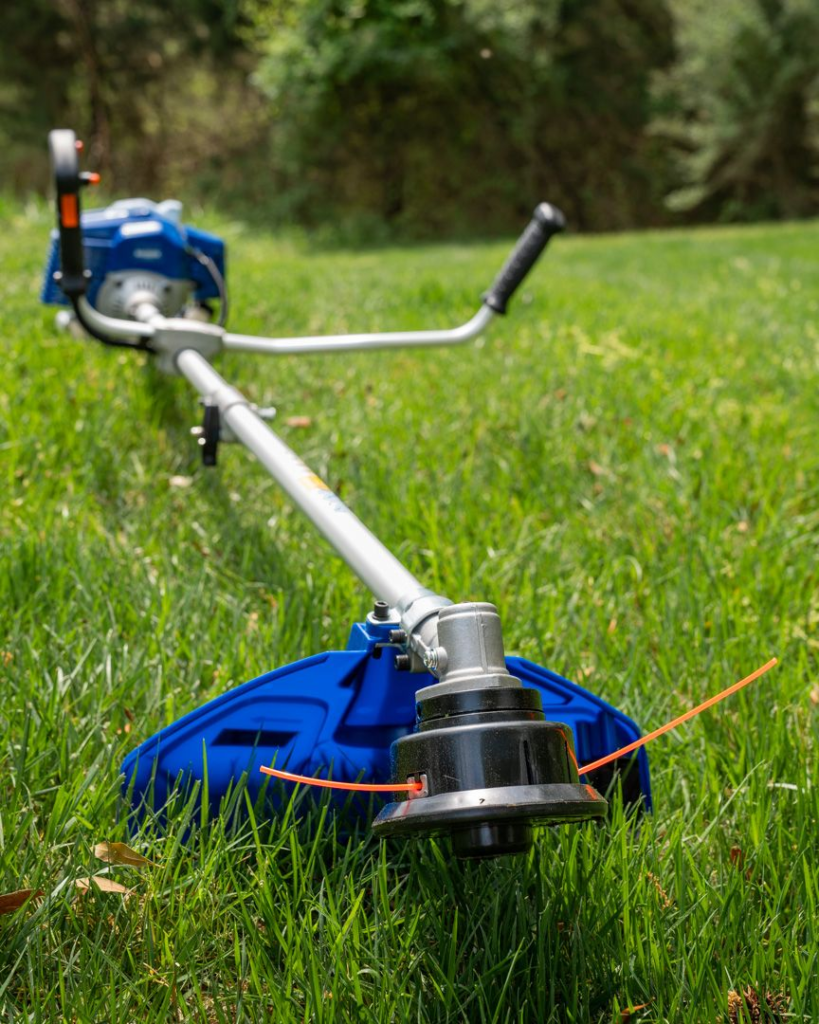
A gas powered weed trimmer — also called a string trimmer, weed eater, or weed whacker — is a handheld outdoor power tool designed to cut grass and weeds in areas that a lawn mower cannot reach. This includes:
- Lawn edges along sidewalks, driveways, and pathways
- Fence lines where mower wheels can’t get close enough to cut cleanly
- Around trees and shrubs where mower decks would cause damage
- On slopes and embankments where mowing is impractical or unsafe
- In tight corners and along garden beds and retaining walls
The cutting mechanism is simple but highly effective: a nylon monofilament line spins at extremely high RPM, slicing through grass and light vegetation with a whipping action. The line wears down during use and is periodically advanced — either manually by bumping the head on the ground or automatically — to maintain cutting length.
Two-Stroke vs. Four-Stroke Gas Powered Weed Trimmers
If you’re shopping for a gas powered weed trimmer, one of the first specifications you’ll encounter is whether the engine is two-stroke (also called two-cycle) or four-stroke (four-cycle). This distinction matters practically.
Two-stroke engines are the traditional choice for gas weed trimmers. They’re lightweight, mechanically simple, and produce excellent power relative to their weight. The tradeoff is that they require a premixed fuel — gasoline blended with two-stroke oil at a specific ratio, typically 40:1 or 50:1. They also produce more emissions than four-stroke engines and tend to be louder.
Four-stroke engines run on straight unleaded gasoline with no mixing required, produce fewer emissions, and are generally quieter and more fuel-efficient. The tradeoff is added weight — four-stroke engines are mechanically more complex and heavier than two-stroke equivalents, which matters significantly in a handheld tool you’ll be operating for extended periods.
For most homeowners, a two-stroke gas powered weed trimmer is the better choice — the weight advantage makes a real difference over long trimming sessions, and the fuel mixing requirement is a minor inconvenience once you establish a routine.
Straight Shaft vs. Curved Shaft Gas Powered Weed Trimmers
The shaft configuration of your gas trimmer affects both reach and usability in meaningful ways.
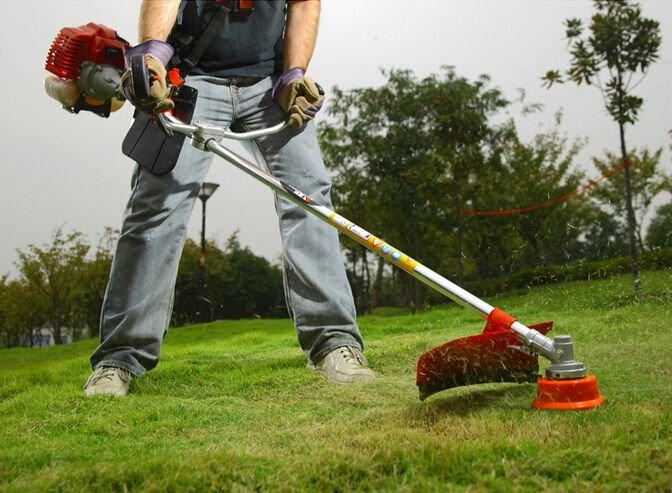
Straight shaft trimmers are longer, providing greater reach under fences, decks, and shrubs. They’re the preferred choice for taller users and for professional applications. The trimmer head on a straight shaft model is typically more accessible for line replacement. Many straight shaft models are also compatible with attachment systems that allow you to swap in edger blades, brush cutters, cultivators, and more — effectively turning your trimmer into a multi-tool platform.
Curved shaft trimmers are shorter and lighter, making them easier to handle for shorter users or those with limited upper body strength. The curved design keeps the cutting head at a more natural angle relative to the ground on flat terrain. They’re typically less expensive than straight shaft models and perfectly adequate for most residential trimming tasks.
For most homeowners buying a gas powered weed trimmer for general yard maintenance, a curved shaft model in the 25–30cc engine range is an excellent starting point. Power users, taller operators, or anyone who wants attachment versatility should step up to a straight shaft model.
Top Gas Powered Weed Trimmer Brands Worth Knowing
The trimmer market is crowded, but a handful of manufacturers consistently stand above the competition in terms of engine quality, durability, and overall user satisfaction.
STIHL — The Professional Standard in Gas Powered Weed Trimmers
STIHL is the brand that professional landscapers reach for when the work has to get done right, day after day. Their FS series gas powered weed trimmers — particularly the FS 56 RC-E and FS 91 R — are built to commercial standards with excellent engine reliability, comfortable ergonomics, and a robust dealer service network.
STIHL trimmers are not the cheapest option on the market, but they deliver a level of build quality and long-term reliability that justifies the investment for serious homeowners. Their two-stroke engines are exceptionally well-tuned, starting reliably in virtually all conditions and maintaining consistent power throughout the fuel tank.
Husqvarna — Engineering Excellence for Demanding Yards
Husqvarna’s gas trimmer lineup mirrors the quality reputation they’ve built in their mower range. The Husqvarna 128LD and 336FR models are particularly well-regarded for their balance of power, weight, and ergonomic design. Husqvarna pioneered several trimmer comfort innovations — including their Smart Start technology that significantly reduces the pull force required to start the engine — that have since become industry standards.
Their straight shaft models with the versatile attachment system are especially compelling for homeowners who want one gas tool that can handle multiple jobs with simple head swaps.
Echo — Reliable Performance at Competitive Prices
Echo has built a strong reputation for producing professional-grade gas outdoor power equipment at price points that are more accessible than STIHL or Husqvarna. Their SRM-225 and SRM-2620 series gas powered weed trimmers offer excellent engine performance, solid build quality, and wide parts availability.
Echo trimmers are a particularly strong value choice for homeowners who want gas reliability without the premium brand price tag. Their two-stroke engines are known for easy starting and consistent power delivery across a wide range of operating conditions.
Ryobi — Best Entry-Level Gas Powered Weed Trimmer
For homeowners who want a capable gas trimmer at the most accessible price point, Ryobi’s gas lineup delivers reliable performance for typical residential applications. Their RY253SS and RY4CSS models offer solid two-stroke power in a comfortable, well-balanced package at prices that make the gas-vs-battery cost comparison very favorable for budget-conscious buyers.
Ryobi’s 4-cycle straight shaft trimmer — which runs on straight gas with no mixing — is an interesting option for homeowners who want gas power without dealing with premixed fuel.
Troy-Bilt — Dependable American Lawn Care
Troy-Bilt’s gas trimmer lineup is built around the same reliability philosophy as their mower products. Their TB35EC and TB4BP EC models offer capable two-stroke performance in ergonomically designed packages. Troy-Bilt trimmers are widely available through major retailers and warehouse clubs, making parts and service easy to access throughout their service life.
Gas Lawn Mowers: Pairing the Right Mower with Your Gas Powered Weed Trimmer
A gas powered weed trimmer does its best work when it’s paired with a gas lawn mower that complements its capabilities. Together, these two tools handle every cutting task your yard presents. Here’s what you need to know about selecting the right gas mower to complete your lawn care setup.
Walk-Behind Gas Mowers — The Backbone of Residential Lawn Care
Walk-behind gas mowers remain the most popular category of lawn mower in the United States, and for good reason. They’re versatile, powerful, and available at price points that suit virtually every budget. Whether you choose a basic push model or a feature-rich self-propelled machine, a quality walk-behind gas mower paired with a gas powered weed trimmer gives you everything you need for professional results.
The Yard Force 21″ Self-Propelled RWD Walk Behind Mower is a compelling option in this category, available through Sam’s Club. This mower features rear-wheel drive self-propulsion for excellent traction on slopes and uneven terrain, a 21-inch cutting deck that balances efficiency with maneuverability, and Yard Force’s innovative Vertical Storage Technology — which allows the mower to be stored upright against a wall, dramatically reducing its footprint in your garage or shed. For homeowners with limited storage space, this feature alone can be a genuine deciding factor.
Rear-wheel drive self-propulsion is particularly noteworthy. Front-wheel drive mowers work well on flat terrain, but the moment you head uphill, the front wheels lose ground contact and traction suffers. Rear-wheel drive maintains contact and grip precisely when you need it most — going uphill. For any yard with meaningful elevation changes, rear-wheel drive is the preferred configuration.
What Makes a Great Gas Walk-Behind Mower?
When evaluating gas walk-behind mowers to pair with your gas powered weed trimmer, keep these specifications in mind:
Engine displacement and brand: Look for engines in the 140cc to 190cc range for standard residential use. Brands like Briggs & Stratton, Honda, and Kawasaki have proven track records in residential mower applications. Higher displacement means more torque for thick grass, but also more weight and fuel consumption.
Cutting deck material: Steel decks are durable and generally preferred for their rigidity and long service life. Some manufacturers use high-impact polymer decks — lighter and rust-resistant, but potentially less durable under heavy use.
Cutting height adjustment: Single-lever adjustment that simultaneously moves all four wheels is a convenience worth prioritizing. Look for a range of at least 1.5 to 4 inches with a minimum of 6 positions.
Discharge versatility: The best gas walk-behind mowers offer 3-in-1 capability — rear bagging, side discharge, and mulching — with easy configuration switching between modes.
Drive system: For yards with any slope or size over 1/3 acre, self-propulsion is worth the investment. Rear-wheel drive for slopes; front-wheel drive for flat terrain; all-wheel drive for the most demanding conditions.
How to Use a Gas Powered Weed Trimmer and Gas Mower Together Effectively
Owning both tools is only half the equation — using them in the right sequence and technique produces results that are noticeably superior to either tool used alone or in the wrong order.
Always Trim Before You Mow
This is the single most important sequencing tip in lawn care, and it’s counterintuitive to many homeowners. Trimming first — before you run the mower — means that any grass clippings or debris thrown by your gas powered weed trimmer will be picked up and processed by your mower on its pass through the same area.
If you mow first and trim second, the clippings from your trimmer sit on top of your freshly mowed lawn as an unsightly scattered layer that you’ll need to blow or rake away. Trim first, mow second — every time.
Match Your Cutting Heights
One of the most common mistakes homeowners make is trimming at a different height than their mower’s cutting setting. When the trimmed edges are shorter than the mowed lawn, you get an obvious contrast line that actually makes the lawn look less professional, not more.
Set your gas powered weed trimmer at the same effective cutting height as your mower deck. For most trimmers, this means adjusting how you hold and angle the tool — slightly tilting the cutting head raises or lowers the effective cut height. Practice on an inconspicuous area until you can match the heights consistently.
Use Edging Technique Along Hard Surfaces
Along sidewalks, driveways, and pathways, rotate your gas powered weed trimmer 90 degrees so the cutting line spins in a vertical plane. This creates a clean, sharp edge that defines the boundary between your lawn and hard surfaces — one of the details that most distinguishes a professionally maintained yard from an average one.
Move slowly and steadily along edges, letting the trimmer line do the work rather than forcing the tool. Rushing creates an uneven, scalloped edge line that undermines the clean look you’re working toward.
Overlap Your Mowing Passes Slightly
When running your gas mower after trimming, overlap each cutting pass by approximately 2 to 3 inches with the previous pass. This ensures no strips of uncut grass are left between passes — a common cause of the “corduroy” striped effect that indicates imprecise mowing technique.
For a striped lawn effect (the alternating dark and light bands you see on professional baseball fields), mow in alternating directions with each session. The different directions of bent grass blades reflect light differently, creating the striping effect without any special attachments.
Gas Powered Weed Trimmer Safety: What Every Operator Should Know
A gas powered weed trimmer is a powerful tool operating at very high RPM with a cutting line that can hurl debris at significant velocity. Respecting the safety requirements of this tool protects both the operator and anyone nearby.
Personal Protective Equipment
Every time you operate a gas powered weed trimmer, you should be wearing:
Eye protection: Safety glasses or a full face shield are non-negotiable. Trimmer line can throw rocks, debris, glass fragments, and other hard objects at speeds capable of causing serious eye injury. Standard prescription glasses do not provide adequate protection — use rated safety eyewear.
Hearing protection: Gas powered weed trimmers are genuinely loud — most produce sound levels in the 90 to 100 dB range at the operator’s ear, well above the 85 dB threshold at which OSHA recommends hearing protection for prolonged exposure. Foam earplugs or earmuff-style hearing protection should be worn on every use.
Protective clothing: Long pants and closed-toe shoes are minimum requirements. Heavy-duty work pants or chaps provide additional protection against debris impacts. Never operate a gas trimmer in shorts or sandals.
Gloves: Protect hands from vibration fatigue and provide grip security, particularly as handles become slippery from sweat during extended operation.
Operational Safety Rules
- Inspect the area before trimming: Walk the area you plan to trim and remove any rocks, sticks, wire, or debris that could be thrown by the cutting line
- Maintain a clear zone: Keep children, pets, and bystanders at least 50 feet away from the operating area
- Never use metal cutting blades unless the trimmer is specifically designed and rated for them — metal blades on a non-rated tool are an extreme safety hazard
- Watch the fuel: Refuel only with the engine stopped and cooled — never add fuel to a running or hot engine
- Secure the area on slopes: Position your footing carefully on uneven terrain and never operate above your capability on steep slopes
Fueling and Mixing for Your Gas Powered Weed Trimmer
Getting the fuel mixture right for a two-stroke gas powered weed trimmer is essential for engine health and performance. Using the wrong mixture — or running straight gasoline in a two-stroke engine — can cause permanent engine damage within minutes.
The Standard Fuel Mix Ratio
Most two-stroke gas powered weed trimmers specify a 50:1 fuel-to-oil ratio — 50 parts gasoline to 1 part two-stroke oil. This translates to approximately 2.6 ounces of two-stroke oil per gallon of gasoline.
Some older models specify a richer 40:1 ratio. Always check your trimmer’s owner’s manual for the manufacturer’s specified ratio and follow it precisely.
Choosing the Right Gasoline
Use fresh, clean, regular unleaded gasoline with an octane rating of 87 or higher. Critically, use gasoline with an ethanol content of no more than 10% (labeled E10). Higher ethanol blends — including the increasingly common E15 — can damage seals, diaphragms, and other fuel system components in two-stroke engines over time.
If your local fuel options frequently include high ethanol content, consider using ethanol-free premium gasoline for your trimmer. It’s more expensive, but it keeps fuel system components in better condition and actually stores longer without degrading.
Fuel Stabilizer for Storage
If your gas powered weed trimmer will be stored for more than 30 days without use, add a fuel stabilizer to the tank before storage. Untreated gasoline begins breaking down and depositing gum and varnish in fuel passages within 30 days — a leading cause of carburetor issues in spring when you pull equipment out of winter storage.
Better yet, run the engine until the fuel tank is completely empty before long-term storage. A dry fuel system is the cleanest way to store a two-stroke engine.
Maintenance Schedule for Your Gas Powered Weed Trimmer
Consistent maintenance is what separates a trimmer that lasts 10 years from one that fails after two seasons. Here’s a practical maintenance schedule for a two-stroke gas powered weed trimmer.
Before Each Use
- Check the fuel level and fuel mixture quality
- Inspect the cutting line — advance or replace if worn short
- Check the trimmer head for cracks or damage
- Inspect the air filter — clean if visibly dirty
Every 25 Hours of Operation
- Clean the air filter thoroughly or replace if damaged
- Check and clean the spark arrestor screen in the muffler
- Inspect the fuel filter and replace if discolored or clogged
- Check all fasteners and tighten any that have loosened from vibration
Every Season
- Replace the spark plug regardless of apparent condition
- Replace the fuel filter
- Clean the carburetor externally and inspect for fuel leaks
- Lubricate the drive shaft (on straight shaft models) with appropriate grease
- Inspect the cutting head for wear and replace if line advancement is inconsistent
Frequently Asked Questions About Gas Powered Weed Trimmers and Gas Lawn Mowers
What is the best gas powered weed trimmer for a large yard? For large yards with extensive trimming requirements, a straight shaft two-stroke trimmer in the 30cc or larger range is the best choice. STIHL’s FS 91 R and Husqvarna’s 336FR are both excellent options that provide the power and runtime for extended large-area trimming sessions without fatigue-inducing weight.
How often should I replace the trimmer line on my gas powered weed trimmer? Trimmer line wears continuously during use. Most operators advance new line every few minutes of trimming — the bump-feed mechanism does this automatically when you tap the head on the ground. You’ll need to replace the entire line spool every few sessions depending on trimming intensity. Keep spare pre-cut line or a spare spool on hand so you’re never caught short mid-job.
Can I use my gas powered weed trimmer as an edger? Yes — most gas trimmers can be rotated 90 degrees to function as a manual edger along hard surfaces. The results are excellent with practice. If you want a dedicated edging tool, many straight shaft trimmer models accept an edger blade attachment that produces even cleaner results with less skill required.
How do I choose between a gas mower and a battery mower to pair with my gas trimmer? If you’re already committed to a gas trimmer, a gas mower is a natural complement — you’re already managing gas and two-stroke oil for the trimmer, so adding a four-stroke mower to the mix is a small incremental step. Battery mowers are a viable alternative if you want quieter mowing, but you’ll then be managing two different energy systems (gas for trimming, battery for mowing), which some homeowners find inconvenient.
Is the Yard Force self-propelled mower good for sloped yards? Yes — the rear-wheel drive configuration of the Yard Force 21″ Self-Propelled RWD Walk Behind Mower is specifically well-suited for sloped terrain. Rear-wheel drive maintains traction going uphill far better than front-wheel drive alternatives, making it a smart choice for yards with meaningful elevation changes.
Final Thoughts: Building the Ultimate Gas Lawn Care Toolkit
A gas powered weed trimmer and a capable gas walk-behind mower are the foundation of a lawn care toolkit that can handle virtually anything your yard throws at them. Together, they cover every cutting scenario — from wide-open lawn expanses to the most confined edges and corners — with the power, reliability, and runtime that gas equipment uniquely provides.
The key is choosing each tool thoughtfully. Match your trimmer’s engine size and shaft configuration to your yard’s demands. Choose a mower with the right drive system, deck width, and discharge versatility for your specific terrain and grass type. Maintain both tools consistently and they’ll reward you with a decade or more of dependable service.
For homeowners looking for an excellent self-propelled gas mower to anchor their setup, the Yard Force 21″ Self-Propelled RWD Walk Behind Mower with Vertical Storage Technology at Sam’s Club is a smart, well-featured choice that delivers genuine value in a compact, storage-friendly package.
And when you’re ready to explore the full range of lawn mowers, trimmers, and outdoor power equipment options available to you, our lawn mower shop is your go-to resource for expert comparisons, curated recommendations, and buying guidance built around your specific lawn care needs.
A perfectly manicured yard is within reach — and with the right gas tools in your hands, it’s easier to achieve than you might think.
