
Uncategorized
Lawn Mower Images: 10 Stunning Visuals That Will Inspire Your Perfect Lawn
Mar
When most people search for lawn mower images, they’re doing more than satisfying casual curiosity. They’re researching. They’re comparing. They’re trying to visualize what a particular type of mower looks like in real-world conditions before committing to a purchase that could cost anywhere from $150 to over $3,000. A picture, as the saying goes, is worth a thousand words — and when it comes to lawn mowers, the right image can instantly clarify the difference between a self-propelled gas model and a zero-turn rider in a way that paragraphs of description simply cannot.
This guide is built around that insight. We’ve paired detailed descriptions of the most important lawn mower images you should be looking at during your buying research with practical information about what each mower type looks like, how it operates, and who it’s best suited for. Whether you’re a first-time buyer trying to distinguish a reel mower from a rotary mower, or an experienced homeowner comparing deck sizes and drive systems on self-propelled models, this visual guide will give you a clearer picture — literally and figuratively — of the lawn mower landscape in 2024.
By the time you finish reading, you’ll know exactly what to look for in lawn mower images when researching your next purchase, which features are most visible and important in product photos, and how to use visual research to shortcut your buying decision and get to the right mower faster.
Why Lawn Mower Images Matter More Than You Think
In the age of online shopping, lawn mower images have become a critical part of the buying process. Unlike a grocery item or a piece of clothing, a lawn mower is a complex piece of equipment with dozens of features that are best understood visually. Deck construction, handle design, wheel size, discharge configuration, battery placement, cutting height adjustment mechanisms — all of these details are far easier to evaluate in a clear product photo than in a written specification list.
Research consistently shows that shoppers who spend time studying detailed product images before purchasing make more confident decisions, experience fewer post-purchase regrets, and are more likely to end up with a product that genuinely meets their needs. In the lawn mower category specifically, where a wrong choice can mean years of frustration with an ill-suited machine, taking the time to properly evaluate lawn mower images is not optional — it’s essential.
Beyond individual product research, lawn mower images also serve an important inspirational function. Seeing a beautifully maintained lawn — fresh mow lines running in clean parallel stripes, edges crisp and defined, grass a deep uniform green — motivates homeowners to invest more care and attention in their own lawns. The right image doesn’t just inform; it inspires action.
Lawn Mower Image #1: The Classic Gas Push Mower
The gas-powered push mower is arguably the most recognizable image in the entire lawn care category. When most people picture a lawn mower, they picture this: a four-wheeled machine with a rectangular steel deck, a vertical engine mounted on top, a fabric grass bag clipped to the rear, and two parallel handles rising to waist height.
In lawn mower images of gas push models, pay close attention to these visual details:
The engine profile: Gas engines sit prominently on top of the cutting deck. A larger engine casing generally indicates higher displacement and more cutting power. Briggs & Stratton, Honda, and Kawasaki engines are among the most recognizable by their distinctive styling and color schemes — red for Honda, black and silver for Briggs & Stratton.
The deck construction: Steel decks appear visually heavier and more substantial than polymer alternatives, which look slightly smoother and more uniform in color. Neither is universally superior, but steel decks are generally more repairable if dented, while polymer decks are rust-proof.
The grass bag: A large, structured rear bag indicates a higher-capacity collection system. Bags that appear flat and fabric-only are simpler but hold less. Hard-frame bags with fabric panels typically offer better airflow and larger capacity.
The wheel configuration: Look at wheel size in product images. Larger rear wheels (8–12 inches) provide noticeably better traction and make the mower easier to push over uneven terrain. Smaller, equal-sized wheels are characteristic of basic entry-level models.
Gas push mowers remain the workhorse of the residential lawn care world, and studying their images carefully gives you real insight into build quality before you ever read a single specification.
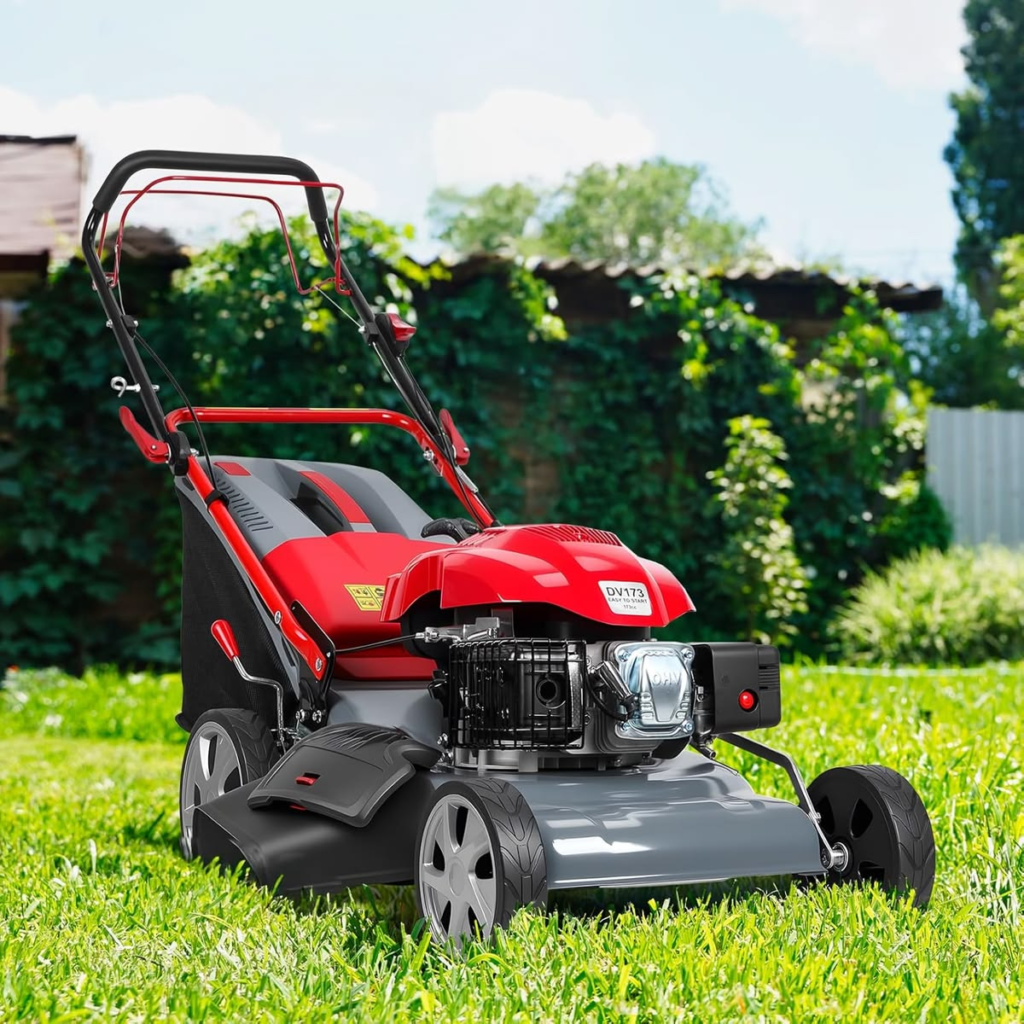
Lawn Mower Image #2: The Self-Propelled Gas Mower in Action
Self-propelled lawn mower images are among the most informative in the entire category because they reveal details about the drive system that fundamentally change how the machine performs. In a quality image of a self-propelled mower, you can often see the drive engagement lever on the handle — a bar or bail that the operator squeezes to engage the drive wheels — as well as visual cues about whether the model uses front-wheel, rear-wheel, or all-wheel drive.
What to look for in self-propelled lawn mower images:
Drive engagement controls: The most visible difference between a self-propelled mower and a basic push model is the presence of a drive cable and engagement lever on the upper handle. In images, this appears as an additional bar or lever above or alongside the blade control bail.
Wheel size differences: Self-propelled models, particularly rear-wheel-drive versions, typically feature noticeably larger rear wheels than front wheels. This size differential is clearly visible in side-profile images and gives the mower better traction going uphill.
Variable speed indicators: Premium self-propelled models feature variable speed controls — often a dial or trigger on the handle — that are visible in detailed handle shots. This is a feature worth identifying in product images because it significantly improves mowing comfort on large or irregularly shaped yards.
Transmission housing: On all-wheel-drive models, a more substantial transmission housing is visible beneath or integrated into the deck. This component distributes power to all four wheels and is a visual indicator of a higher-specification drivetrain. Lawn Mower Images
One excellent real-world example of what a quality self-propelled mower looks like — both in product images and in person — is the Yard Force 21″ Self-Propelled RWD Walk Behind Mower with Vertical Storage Technology. Its rear-wheel-drive system, 21-inch steel deck, and innovative vertical storage design make it visually distinct from standard push models and represent exactly the kind of feature-rich self-propelled mower that lawn mower images can help you identify and evaluate before purchase.

Lawn Mower Image #3: Battery-Powered Cordless Mowers — The Modern Look
Battery-powered lawn mower images have a distinctly modern aesthetic that sets them apart immediately from gas models. Without a bulky combustion engine on top of the deck, cordless mowers have a cleaner, lower-profile appearance. The battery pack — typically mounted at the rear of the deck near the handle base — is the most visually distinctive feature.
What to identify in battery mower images:
Battery placement and size: The battery pack is the most visually prominent component on any cordless mower. Larger battery packs (indicated by higher Ah ratings) are physically bigger and more prominent in product images. A high-capacity 7.5 Ah or 10 Ah battery looks substantially different from a basic 2.5 Ah pack — and that size difference translates directly to run time.
Voltage indicators: Many brands color-code their battery platforms — EGO uses a distinctive arc-shaped green battery, Ryobi uses bright green as a brand color, and Greenworks uses a deep forest green aesthetic. These color and form cues are immediately recognizable in lawn mower images and help identify battery compatibility across a brand’s tool ecosystem. Lawn Mower Images
Motor housing vs. engine: Where a gas mower has a protruding engine block on top of the deck, a battery mower has a flat or slightly raised motor housing integrated into the deck itself. This gives battery mowers a sleeker, more low-profile appearance that many homeowners find visually appealing.
Push button start: Look for the prominent push-button ignition on the handle panel — a detail visible in close-up lawn mower images that signals the ease-of-use advantage of electric starting over a pull-cord gas system.

Lawn Mower Image #4: The Zero-Turn Riding Mower — Power and Precision
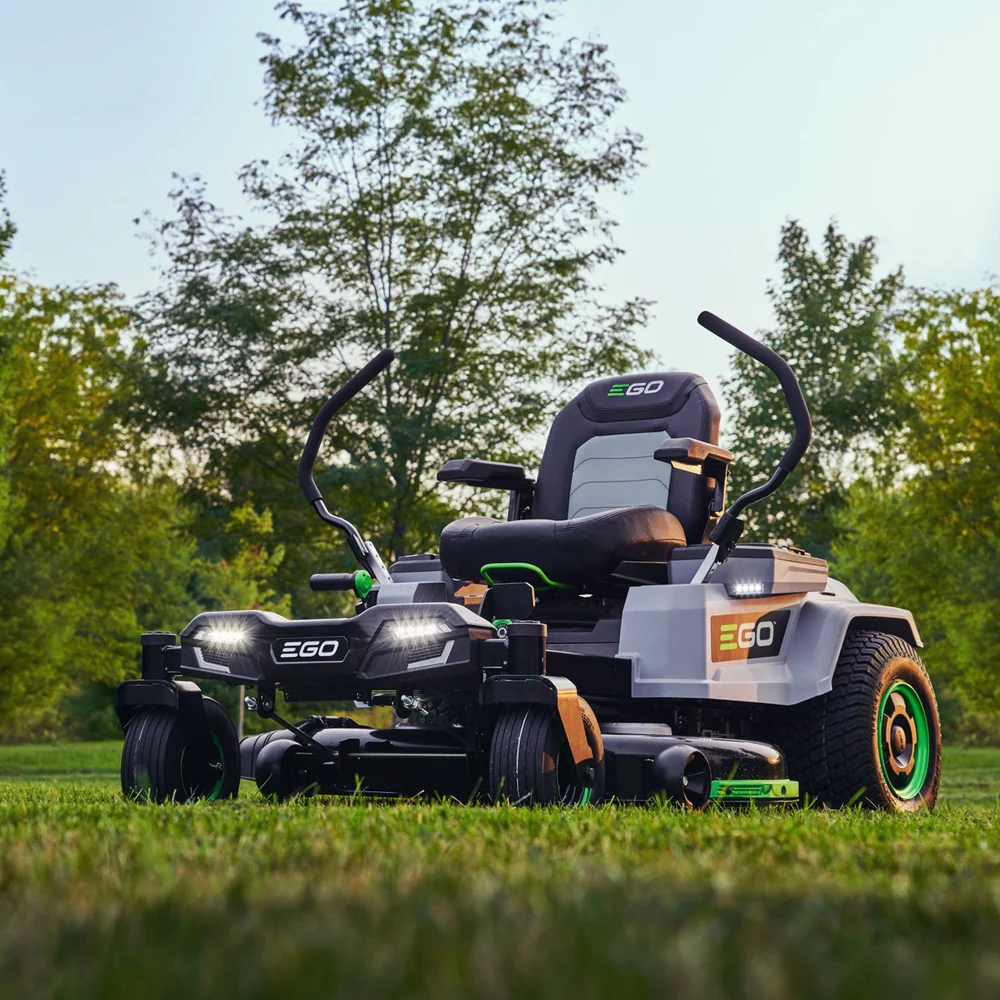
Zero-turn riding mower images are genuinely dramatic. These machines look unlike anything else in the lawn care category — wide, low-slung, with twin lap bar controls replacing the conventional steering wheel of a lawn tractor. Their cutting decks extend well beyond the width of the operator platform, giving them an aggressive, purposeful appearance that signals serious cutting capability.
Key visual features to identify in zero-turn lawn mower images:
Lap bar controls: The most immediately distinctive visual feature of a zero-turn mower is the twin lap bar control system. Two individual levers — one for each rear drive wheel — replace the conventional steering wheel entirely. Pushing both levers forward accelerates the mower straight ahead; pushing one lever more than the other turns the mower. Pulling one lever back while pushing the other forward causes the mower to spin on its axis — the zero-turn capability that gives these machines their name.
Deck width: Zero-turn decks are dramatically wider than walk-behind mowers. Standard residential zero-turns feature decks from 42 to 54 inches wide, and commercial models extend to 72 inches. This width is immediately apparent in front-on or three-quarter-angle images.
Operator platform: Zero-turn mowers feature a substantial operator platform with a padded seat, often with armrests on premium models. The seating position is low and centered over the rear axle, giving the operator excellent visibility of the cutting deck ahead.
Frame construction: The steel tube frame of a zero-turn mower is visible in many product images and is a good indicator of build quality. Heavier gauge tubing and more substantial welded connections indicate commercial-grade durability. Lawn Mower Images
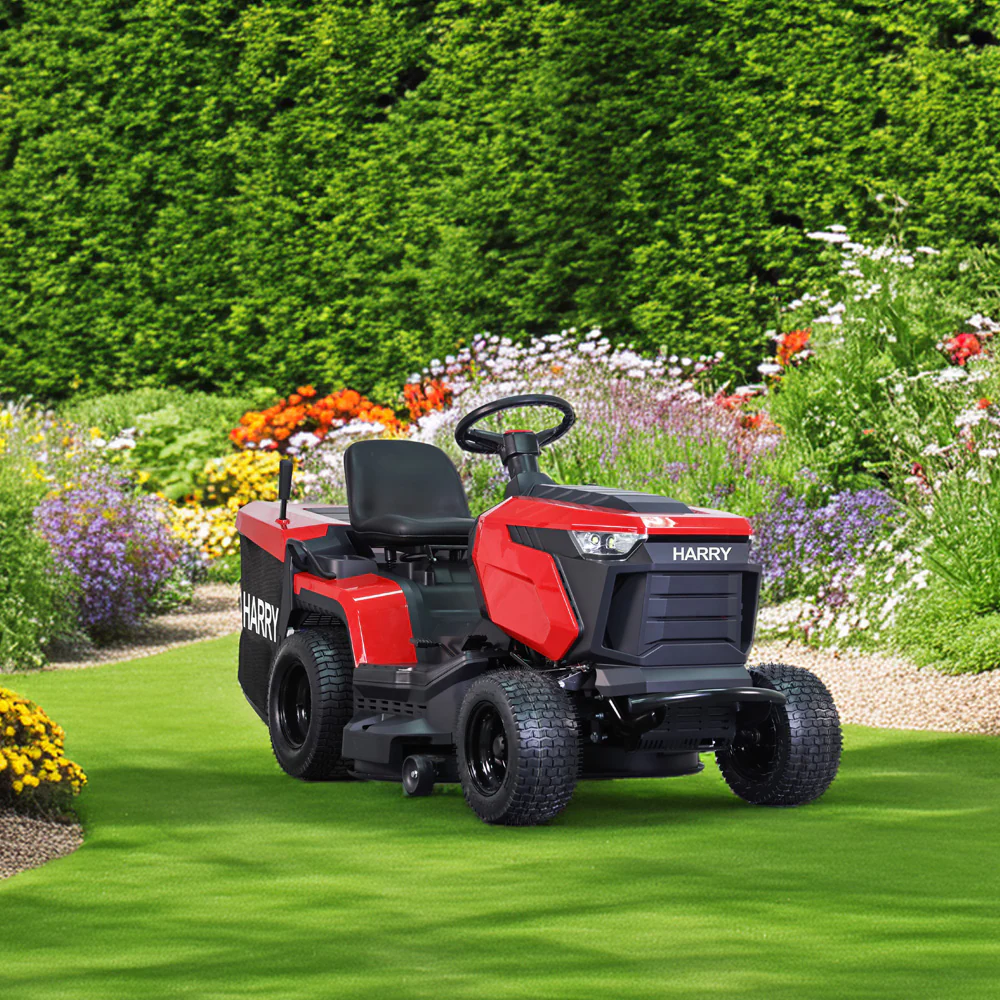
Lawn Mower Image #5: The Lawn Tractor — The Classic Riding Experience
Lawn tractor images are immediately familiar to most homeowners — these are the riding mowers that most people envision when they think of a riding lawn mower. A conventional steering wheel, a hood covering the front-mounted engine, and a cutting deck positioned beneath the operator’s seat between the front and rear axles. Lawn Mower Images
What lawn tractor images reveal about the machine:
Hood design and engine access: The hood of a lawn tractor covers the engine compartment and its design varies significantly between manufacturers. Premium models feature hoods with internal reinforcement and easy-open hinges for maintenance access. Lower-quality models may have thinner, flimsier hoods that show more flex in motion.
Cutting deck positioning: On a lawn tractor, the cutting deck is a separate component that hangs beneath the frame between the front and rear axles. In product images, look for the deck lift lever — typically a large red or orange handle near the operator seat — which raises and lowers the deck to adjust cutting height.
Transmission type indicators: Automatic or hydrostatic transmissions — which allow smooth, stepless speed control — are indicated visually by the absence of a gear shift lever. Manual transmission models will show a visible shift mechanism. Hydrostatic transmissions are strongly preferable for most residential users.
Turning radius: While you can’t directly measure turning radius from an image, you can get a sense of it from the wheelbase length. Longer wheelbases indicate larger turning radii — an important consideration if your yard has lots of obstacles. Lawn Mower Images

Lawn Mower Image #6: Reel Mowers — Simple, Clean, Timeless
Reel mower images have a clean, almost architectural simplicity that stands out sharply from the mechanical complexity of powered alternatives. The defining visual element is the cylindrical reel of blades — typically five to seven helical blades arranged around a central axle — positioned at the front of the machine where a gas mower would have its rotary blade hidden beneath a deck. Lawn Mower Images
Visual features to identify in reel mower images:
The blade reel: The helical blade cylinder is the entire cutting mechanism of a reel mower, and it’s fully visible in most product images. Count the blades — more blades generally produce a finer, more frequent cut. Five-blade reels are standard; seven-blade reels are found on premium models and produce a finer cut quality. Lawn Mower Images
Frame construction: Modern reel mowers have surprisingly lightweight, slim frames compared to powered mowers. The absence of an engine or motor means the entire machine can be built around a minimal structural framework. This lightness is apparent in images and is one of the machine’s genuine practical advantages. Lawn Mower Images
Handle design: Reel mower handles are typically simpler than powered mower handles — no control levers, no bail systems, no drive engagement mechanisms. Just a clean, padded grip bar connected to the frame. Some premium models feature adjustable handle heights, which may be visible in detailed product shots.

Lawn Mower Image #7: Robotic Lawn Mowers — The Future Arrives
Robotic lawn mower images are perhaps the most striking departure from traditional lawn care equipment aesthetics. These compact, disc-shaped or rounded-rectangular machines bear more visual resemblance to robotic vacuum cleaners than to any conventional mower — and that’s entirely intentional.
Key visual features in robotic mower images:
Form factor: Robotic mowers are low, compact, and rounded to navigate around obstacles without getting caught. Most models are between 20 and 30 inches in length and sit close to the ground, with a smooth upper shell that sheds rain and debris.
Charging station: Robotic mower product images almost always include the charging station — a flat base unit connected to a power cord that the mower automatically returns to when its battery runs low. The relationship between mower and station is a defining visual element of this category.
Navigation systems: Some robotic mowers feature GPS antennas, camera arrays, or sensor bumpers visible on their upper shell. These components are worth identifying in images because they indicate the sophistication of the mower’s navigation system and its ability to handle complex yard layouts.
Boundary wire vs. virtual boundary: Some robotic mowers use a physical boundary wire that must be installed around the perimeter of the mowing area. Others use GPS or vision-based virtual boundary systems that require no physical installation. This distinction isn’t always visible in images, but the presence of included wire and stakes in the product package image is a clear indicator of a wire-based system.

Lawn Mower Image #8: Mulching Mowers and Their Distinctive Deck Design
Mulching mowers look similar to conventional push mowers at first glance, but detailed lawn mower images reveal important differences in deck design that indicate their superior grass-processing capability.
What makes mulching mower images distinctive:
Sealed deck design: True mulching mowers feature a sealed or partially sealed deck with no side discharge opening. This forces clippings to circulate beneath the deck and be recut multiple times before settling onto the lawn as fine mulch. In images, look for a deck without a side discharge chute — or one with a removable side discharge plug.
Blade profile: Mulching blades have a different profile from standard cutting blades — they feature additional lift curves and cutting surfaces that generate the airflow needed to repeatedly recirculate clippings. In close-up images, mulching blades appear more curved and complex than flat standard blades.
Deck depth: Mulching decks are typically deeper than standard cutting decks to provide the internal air circulation space needed for effective mulching. This depth can be visible in side-profile images, though it requires a practiced eye to distinguish from standard deck designs.
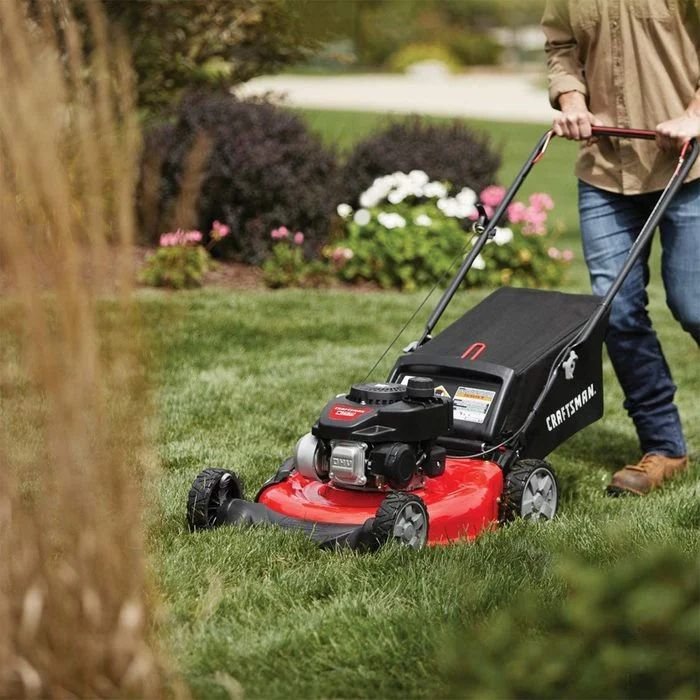
Lawn Mower Image #9: Wide-Area Walk-Behind Mowers for Large Lawns
Wide-area walk-behind mowers occupy an interesting visual middle ground between conventional push mowers and riding tractors. They look like push mowers — you walk behind them and guide them by hand — but their cutting decks are dramatically wider, ranging from 26 to 33 inches compared to the 21-inch standard.
Visual characteristics of wide-area mowers:
Deck width proportion: The most immediately obvious visual feature is the deck width relative to the operator’s body. On a standard 21-inch mower, the deck barely exceeds shoulder width for most operators. On a 30-inch wide-area mower, the deck extends well beyond shoulder width on both sides — a dramatic visual difference that immediately communicates the machine’s efficiency advantage.
Dual-blade systems: Wide-area mowers typically use two parallel cutting blades rather than a single large blade. In under-deck images, this dual-blade configuration is clearly visible and is an important indicator of how the mower handles the wider cutting width.
Drive system prominence: Wide-area mowers are almost always self-propelled — the deck is too wide and too heavy for comfortable manual pushing. The drive system components are therefore more prominent in these machines, with larger rear wheels and more substantial drive housing visible in product images.
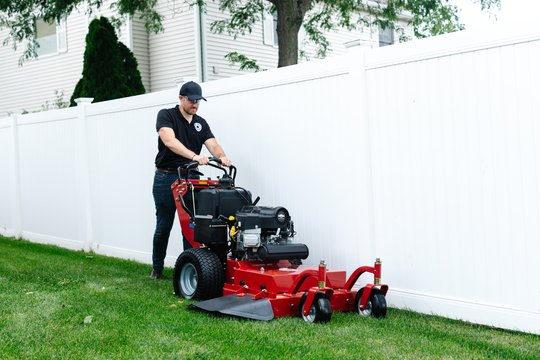
Lawn Mower Image #10: Commercial Walk-Behind Mowers — Professional Grade
Commercial walk-behind mower images have a distinctly purposeful, heavy-duty aesthetic that separates them immediately from residential models. These machines are built to mow for eight or more hours per day, five or more days per week, and their construction reflects that standard.
What commercial mower images reveal:
Frame and deck construction: Commercial mower decks are visibly heavier and more robustly constructed than residential alternatives. Thicker steel gauge, reinforced corners, and more substantial welding are all visible in detailed product images.
Engine placement and size: Commercial mowers typically feature larger, more prominent engines — often from Kawasaki, Kohler, or Honda Commercial series — with distinctive styling that’s recognizable to experienced equipment buyers.
Operator controls: Commercial mowers feature more sophisticated operator control systems than residential models. Dual hydrostatic controls, padded operator presence bars, and precision blade engagement systems are all visible in detailed handle and control area images.
Tire and wheel construction: Commercial mowers use heavier-duty tires and wheel assemblies than residential models. Knobby, larger-diameter tires for improved traction in all conditions are a consistent visual indicator of commercial-grade equipment.
How to Use Lawn Mower Images Effectively in Your Buying Research
Now that you know what to look for across every major category of lawn mower images, here’s a practical framework for using visual research most effectively in your buying process.
Start With Category Images, Then Narrow to Models
Begin your research by looking at broad category images — gas push mowers, battery mowers, zero-turns — to confirm which type is right for your yard. Once you’ve confirmed the category, narrow your image search to specific brands and models to compare build quality, features, and design details at a closer level.
Use Multiple Angles — Not Just the Hero Shot
Product pages typically feature a main “hero” image that shows the mower from its most flattering angle. But the most useful lawn mower images for research purposes are the additional shots: the under-deck view, the handle detail, the side profile, the rear bag or discharge area, and any included accessories. Always seek out multiple angles before making a judgment about any specific model.
Compare In-Use Images Against Product Shots
Product photography is carefully controlled and often makes equipment look more substantial and well-built than it appears in person. Supplement product images with in-use photography — images of the mower being operated in real grass conditions — to get a more accurate sense of its actual size, maneuverability, and real-world performance.
Pay Attention to Background Details in Lifestyle Images
In lifestyle lawn mower images — where the machine is shown operating in an actual yard rather than against a studio background — the surrounding environment often reveals useful context. Lawn size, grass type, terrain slope, and landscaping complexity all appear in the background and help you assess whether the featured mower is suited to conditions similar to yours.
Use Image Research to Confirm Spec Sheet Claims Lawn Mower Images
Manufacturers make many claims about deck construction, engine quality, and feature availability. A careful review of detailed lawn mower images can often confirm or contradict those claims. Thin metal, visible plastic where the spec sheet claims steel, or simplified control layouts that don’t match described features are all things that attentive image review can reveal before you commit to a purchase.
Where to Find the Best Lawn Mower Images for Your Research
Manufacturer websites are the best source for high-resolution, multi-angle product images. Most major brands — EGO, Honda, CRAFTSMAN, Husqvarna, Toro — maintain extensive media galleries with detailed photography of every model in their current lineup.
Retailer product pages often feature both manufacturer-supplied images and user-submitted photos that show the mower in real-world conditions. User-submitted images are particularly valuable because they’re unfiltered and show the machine as it actually appears outside of studio conditions.
Video reviews on YouTube are an underused source of visual information. A thorough video review will show every angle of a mower — including the underside of the deck, the drive system, and the height adjustment mechanism — in ways that still photography sometimes misses.
Owner community forums and subreddits dedicated to lawn care often feature owner-submitted images of mowers in real-world use, including after months or years of service. These images are invaluable for assessing long-term durability and real-world performance.
For curated, expert-reviewed selections across every mower category, visit our lawn mower shop where you’ll find detailed product imagery alongside honest, experience-based recommendations for every yard type and budget.
Frequently Asked Questions About Lawn Mower Images and Buying Research
Why do lawn mower images matter when shopping online? Online purchases of complex equipment like lawn mowers carry inherent risk because you can’t inspect the product in person before buying. Detailed, multi-angle lawn mower images reduce that risk by allowing you to evaluate build quality, design details, and feature availability visually — much like an in-store inspection, but from the convenience of your home.
What should I look for in lawn mower images to assess build quality? Focus on material consistency, weld quality at structural joints, hardware finish, and the thickness and rigidity of the cutting deck. Thin, flimsy-looking decks, visible plastic where metal is expected, and rough or uneven welds are all red flags visible in detailed product images.
Are lifestyle lawn mower images more useful than product shots? Both serve different purposes. Product shots are best for evaluating specific features and build details. Lifestyle images showing the mower in actual operating conditions are better for assessing real-world size, maneuverability, and performance. Use both for the most complete picture.
Can I tell battery life from lawn mower images? Not precisely, but you can make informed inferences. A physically larger battery pack generally indicates higher capacity and longer run time. Look for the battery dimensions in product images and compare them across models in the same voltage platform.
Where is the best place to compare lawn mower images side by side? Retailer comparison tools — available on major retail sites — are the most convenient way to view multiple mower images side by side. Manufacturer websites offer the highest quality individual images. For expert-curated comparisons with honest visual and performance assessments, our lawn mower shop is built specifically to help you make that comparison efficiently.
Final Thoughts: Let Lawn Mower Images Guide Your Best Purchase Decision
The best buying decisions begin with the best information — and in the lawn mower category, visual information is among the most valuable kind. Studying lawn mower images carefully, across multiple angles and real-world conditions, gives you insight that no specification sheet can fully replicate. It helps you see the quality of construction, understand the scale and ergonomics of the machine, and visualize how it will actually perform in your specific yard.
From the clean simplicity of a reel mower to the commanding presence of a zero-turn rider, every category of lawn mower has a visual signature that communicates something real and useful about its design philosophy and intended use. Learning to read those visual cues is a skill that will serve you well not just for this purchase, but for every piece of outdoor equipment you buy in the future.
If you’re ready to move from visual research to a real purchase decision, two resources deserve your attention. First, explore the Yard Force 21″ Self-Propelled RWD Walk Behind Mower with Vertical Storage Technology at Sam’s Club — a visually distinctive, feature-rich self-propelled mower whose innovative vertical storage design makes it as practical to own as it is effective to operate. Second, visit our lawn mower shop for the full range of curated mower recommendations, expert reviews, and visual comparison tools that will help you land confidently on the right machine for your lawn.
A beautiful lawn starts with the right mower. And finding the right mower starts with knowing exactly what you’re looking at.
